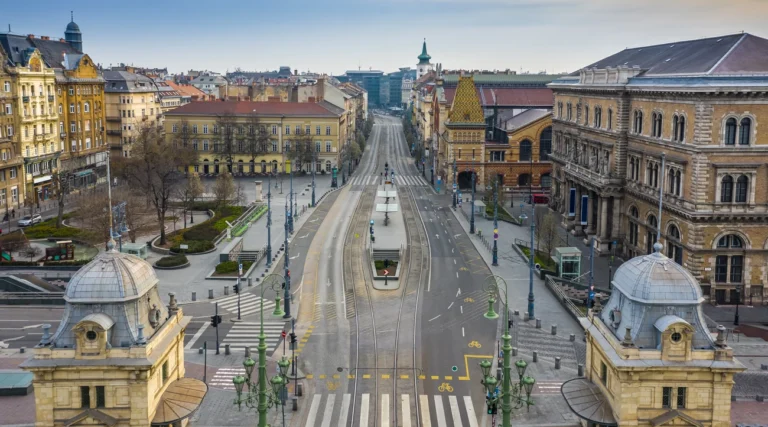
Andrássy Avenue changes as you walk out from the centre. Busy shops and the Opera give way to tree-lined promenades, then villa gardens and the approach to Heroes’ Square. Pick the stretch that suits your day instead of treating the entire boulevard as one compulsory march.
- Use Oktogon and Kodály körönd to divide the walk into manageable sections.
- M1 provides an alternative when you have walked far enough.
- Opera performances, museum visits and interiors require separate plans.
Choose one of the avenue’s three different stretches
The most useful planning decision is where to begin and where to stop. The central stretch suits façades, shops and the Opera; the middle gives more space to notice the residential streets; the outer section works as an approach to Heroes’ Square and City Park. You can enjoy one without completing all three.
The Opera end: look up beyond the shop windows
The Hungarian State Opera House is the great architectural anchor of the central section. Miklós Ybl’s building rewards a look from across the street as well as from close to its entrance. Compare the depth of the façade and its sculpture with the surrounding palaces rather than concentrating only on the shopfronts at eye level.
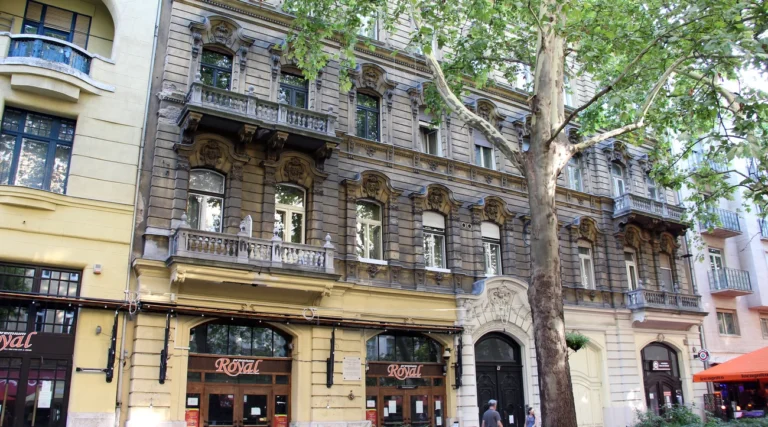
The nearby theatre streets contribute to the “Pest Broadway” character of this end of the avenue. A performance or an interior visit changes the day’s timetable: choose it deliberately, and keep the outdoor walk as a separate part of the plan.
Beyond Oktogon, trade the shopping pace for a slower walk
Oktogon is a natural reset point. Beyond it, the avenue’s tree-lined promenades and residential scale become more noticeable. Continue towards Kodály körönd if you want to read the street itself, or stop for an indoor visit without feeling that the park must also fit into the same afternoon.
Budapest’s official visitor guide identifies the House of Terror, Hungarian University of Fine Arts, Franz Liszt Memorial Museum and Ferenc Hopp Museum of Asian Art among the avenue’s institutions. They represent different subjects and moods. Choose one according to your interests; do not treat them as interchangeable boxes to tick.
The villa section leads naturally towards Heroes’ Square
After Kodály körönd, the avenue becomes greener, with villas, gardens and embassies. Heroes’ Square is the visual destination, while City Park gives you somewhere to change pace afterwards. Decide whether the square, a museum or a park walk will be your endpoint before adding another large visit.
The Museum of Fine Arts and the park’s cultural buildings deserve their own time. A long avenue walk followed by a major museum and a thermal bath can become more tiring than the map suggests. Choose a main activity and keep the rest flexible.
- The public avenue is free to walk.
- World Heritage recognition covers the urban ensemble, not a single bookable attraction.
- Museums and the Opera have separate access arrangements.
- Private gardens and institutional buildings are not open simply because you can see them from the street.
- Choose a starting point and an endpoint before setting out.
- Use marked crossings at the large junctions.
- Keep a valid transport ticket or pass ready if you switch to M1.
- Allow a buffer before a performance or a timed indoor booking.
Use M1 to choose your starting point and shorten the return
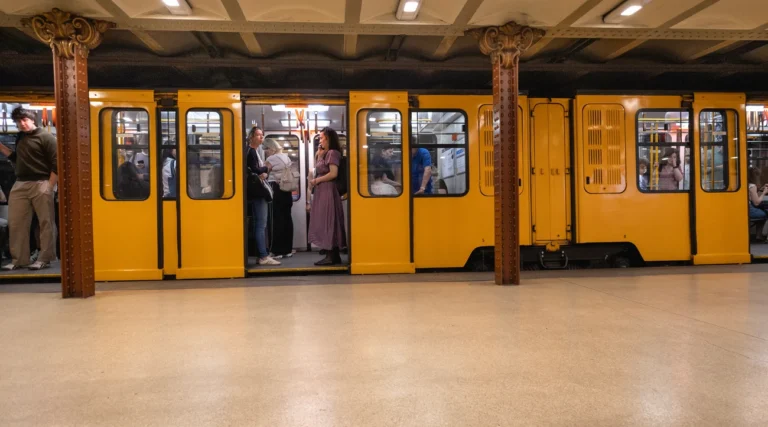
M1 follows the avenue’s corridor and makes it practical to walk one section rather than the whole route. Opera, Oktogon, Kodály körönd and Hősök tere are useful references for different parts of the walk. Select the station that matches your actual stop, then check BKK’s current route information for any temporary changes.
Staying near the avenue: choose the right stretch for your days
A base near the Opera is different from one near the park. The inner blocks suit central Pest evenings and short walks to other sights; the outer stretches offer a different rhythm and depend more on the particular address and transport connection. Our stay guide compares the Opera, Oktogon and City Park ends rather than presenting the entire avenue as one hotel location.
A nineteenth-century boulevard designed for a growing capital
Andrássy Avenue became a symbol of Budapest’s emergence as a modern metropolis. UNESCO identifies the avenue’s development in 1872–1885 and the Millennium Underground Railway of 1893–1896 as connected examples of urban planning and new transport technology.
The avenue and its surroundings were added to Budapest’s World Heritage property in 2002. Its significance lies in the ensemble: the buildings, street plan, public spaces and underground line work together. The change from central palaces to greener villa plots is part of what makes a walk along it interesting.
City passes and guided walks for a wider Budapest plan
Andrássy Avenue walking questions