Start with the station printed on your ticket. Budapest has several main railway stations, so “Budapest” alone is not enough to plan your arrival. Keep the station, train number and onward city connection together.
- Keleti, Nyugati, Déli and Kelenföld have different metro connections.
- HÉV is suburban rail: check the fare boundary before travelling outside the city.
- Ferihegy station is outside Terminal 2. Bus 200E provides the terminal connection.
- Buy the right ticket before boarding and check reservation requirements for your chosen train.
Which Budapest station does your train use?
Read the full station name when booking and again before departure. The main stations are spread across Buda and Pest. Their metro links make onward travel straightforward, provided you plan from the station your train actually uses.
A train can call at more than one Budapest station, but do not assume that your ticket permits a different boarding point. Check the booked route and the current departure information, especially when engineering work changes a terminus.
Changing stations: leave time between platforms
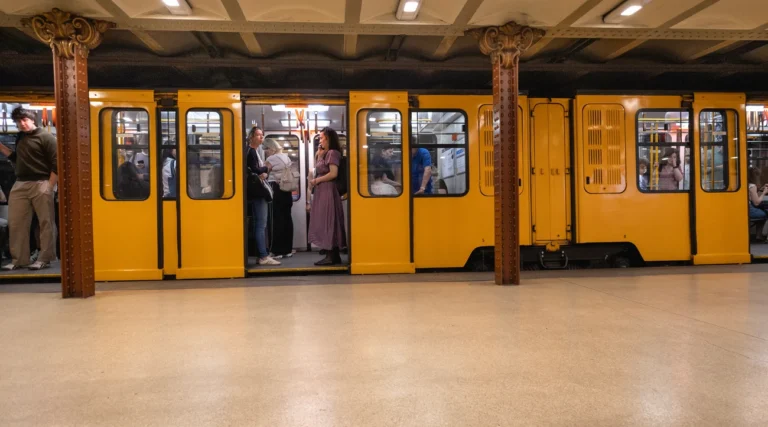
A station transfer is part of the journey. Keleti and Kelenföld are linked by M4; Keleti and Déli by M2. Nyugati uses M3, so some transfers require a metro change. Include the walk between the railway platform and metro entrance, ticket purchase and time to find the next platform.
Plan the route in BudapestGO for the actual day. Leave a comfortable interval for luggage and unfamiliar exits rather than comparing only the time spent on the metro.
HÉV journeys and the city fare boundary
HÉV has its own city-boundary rules. The table identifies the standard boundary stations. A Budapest ticket, travelcard or pass covers only its valid city section; a journey beyond it needs the appropriate suburban coverage as well.
For H5 to Szentendre, check both the Budapest section and the journey beyond Békásmegyer. Regional products can cover a different area: compare the exact product rules before buying overlapping tickets.
- Buy in advance: use a ticket machine, office or supported rail sales service before boarding where sales facilities are available.
- Check the route: a suburban ticket for the outer HÉV section does not automatically cover the city section.
- Keep both parts: retain your city and suburban travel documents for inspection.
- A single BKK ticket allows one uninterrupted HÉV ride within its valid city section; a transfer from the metro needs separate coverage.
- Do not confuse a Budapest travelcard with a Pest County or Hungary product.
- Check any replacement bus and its boarding point before setting out.
Mainline tickets, reservations and boarding
A railway booking and an ordinary city ticket are different products. Read the validity of the ticket or pass you hold for the specific service, class and route. Some longer-distance trains also require a reservation.
- Choose the exact stations. Check the date, train and destination before paying.
- Read the fare conditions. Confirm whether a seat reservation is included or required.
- Keep the ticket accessible. Have the document and any supporting ID ready for inspection.
- Check the departure board. Match the train number and platform rather than following another departure to the same city.
For a visitor making ordinary city journeys, the metro is often easier to interpret than mainline rail validity. If a planner suggests a mainline train, verify that service against your exact travel product rather than assuming a BKK single ticket covers it.
Ferihegy: a train connection with a bus to the terminal
Ferihegy railway station is not a train station inside Terminal 2. Trains connect it with Nyugati; bus 200E links the station and the airport terminal. Allow time for the bus, the interchange and the onward train, not just the rail journey.
This connection can suit a journey via Nyugati or an onward rail trip. Compare it with 100E to central Pest and 200E plus the metro for your accommodation address. Check the validity of both the bus and train tickets separately.
Luggage, platform access and assistance
Check the complete route if steps or a long platform walk would be difficult. A metro lift does not establish that the railway platform, train doorway and final station exit are suitable for your needs.
Ask the railway operator about assistance and the chosen service before relying on the journey. Include luggage, boarding arrangements, the correct station entrance and enough transfer time in the plan. Check current lift and service information for any metro connection too.
Nyugati and Keleti: working railway landmarks
Nyugati opened in 1877 and Keleti followed in 1884. Their grand station buildings belong to the nineteenth-century expansion of rail travel. They remain working gateways, so enjoy the architecture while keeping departure boards and platform access in view.
Nyugati replaced an earlier Pest station on the same site. Keleti was built later as the railway network expanded. The separate terminals explain why a journey across Budapest can still include a transfer between stations.
For a visitor, the useful distinction is practical as well as architectural: choose the station required by your train, then plan its own metro connection.
Plan the visit after your arrival
Rail travel gets you to the city; admission and guided outings are separate choices. Compare a city pass only against the visits and transport it actually includes. A Castle District tour has its own meeting point, so allow time to reach it from the arrival station.
Frequently asked questions