Óbuda rewards a day built around a small historic centre rather than a long checklist. Start at Fő tér, where the town hall, museum buildings and cafés sit close together, then follow the smaller streets of the Krúdy Quarter. The change of pace is the attraction: ordinary neighbourhood life sits alongside Roman remains and substantial collections.
Do not treat the whole third district as one walk. The Main Square museums form one cluster; Aquincum lies farther north and needs a separate journey or a longer plan. Choose the collection you most want to see before deciding how far to extend the day.
Fő tér first: finding the compact heart of a large district
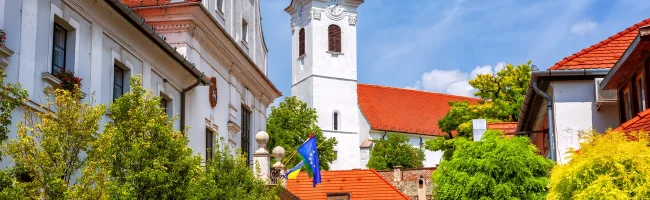
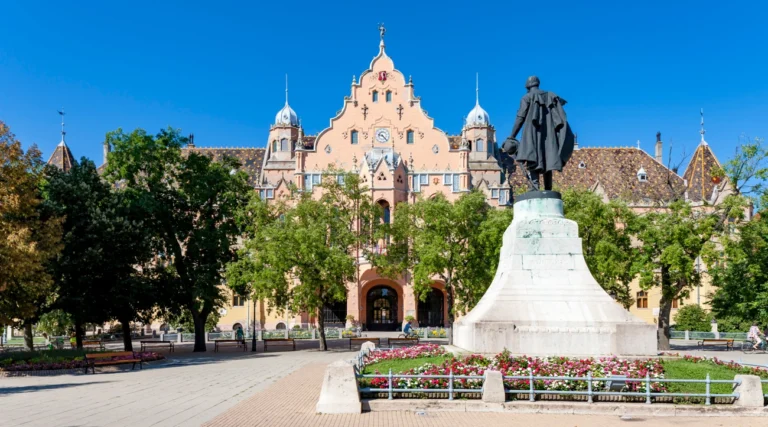
Óbuda-Békásmegyer occupies a large area on the Buda side of the Danube. For a first visit, Fő tér gives you a much smaller and more manageable focus. The town hall and Zichy museum complex anchor the setting, while Esernyős at number 2 combines a café, gallery and tourist information point.
Look at how these places relate before heading indoors. The square is useful for orienting yourself, but it is also a setting for cultural and seasonal events. A busy programme can change the atmosphere and available space; it does not turn the wider district into a pedestrian old town.
- A compact historic core around Main Square and museum courtyards.
- Collections ranging from local history to optical and avant-garde art.
- A café and information point at Esernyős, Fő tér 2.
- Roman heritage gives a different historical layer to the wider area.
- The whole district is much larger than the Main Square cluster.
- Museum opening days and tickets differ.
- Vasarely is closed on both Monday and Tuesday.
- Aquincum and Római-part need deliberate extensions, not casual detours.
Six places to understand Óbuda, without trying to do them all
Use Main Square as the centre of the visit and choose one or two nearby interests. These stops describe different sides of Óbuda; Aquincum belongs to a separate northern extension rather than the same short walking loop.
A museum day needs a calendar: Vasarely and the courtyard collections
The Vasarely Museum is an option again after reopening on 16 September 2026. Its current published schedule is Wednesday–Sunday, 10:00–18:00, with ticket office and admission ending at 17:00; the exhibitions begin closing at 17:45. Monday and Tuesday are closed. Check holiday notices and the exhibition calendar before travelling.
Do not apply those hours to every neighbouring museum. The Óbuda Museum follows local history from the Middle Ages into the twentieth century, while the Kassák and other collections have their own programmes. One carefully chosen collection leaves more room for the streets than trying to move through several museums in a row.
The Krúdy Quarter: follow the smaller streets, then stop
The Krúdy Quarter offers a more intimate continuation beyond Main Square. Its name recalls writer Gyula Krúdy, while the local tourist information describes a setting of small restaurants, cafés, museums and historic religious buildings. Let this be the slower part of the outing rather than a race towards another headline attraction.
Esernyős is a useful first pause because it combines refreshments with information on the district’s cultural life. Choose food from the current menu and check opening on arrival; no café service, meal or seasonal terrace is guaranteed by a museum ticket. A short walk and an unhurried stop can be enough to make the neighbourhood feel different from central Pest.
Roman Óbuda: do not confuse the amphitheatres with Aquincum Museum
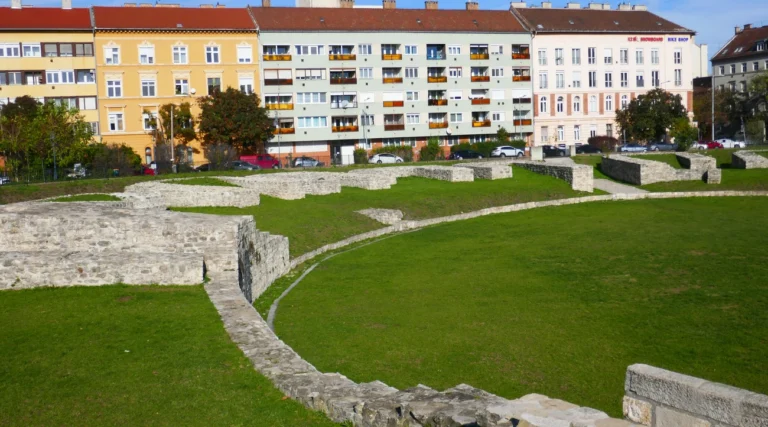
Roman remains appear in several parts of Óbuda. The district’s history includes the civilian town at Aquincum as well as military sites and two amphitheatres. The military amphitheatre shown in this guide’s main photograph sits among later residential buildings: it is not the same place as the paid archaeological park farther north.
For a first visit, decide whether Roman archaeology is the main purpose of the day. If it is, build the journey around Aquincum’s museum and park hours. If you mainly want Main Square and a collection, leave the northern extension for another day. The Bath Museum currently has a closure notice; do not add it as a guaranteed open stop.
- Do not apply one museum’s hours to the entire cluster.
- Keep Main Square and Aquincum as distinct parts of the plan.
- A general city pass does not replace checking the named museum’s inclusion.
- Do not assume every Roman site has the same access arrangements.
- Choose your museum before selecting the day of the week.
- Start at Fő tér and ask about the current local programme.
- Leave time for a café and a smaller street loop.
- Use transport rather than forcing a long extension when tired.
Arriving at Szentlélek tér for the Main Square area
H5 links Batthyány tér with Szentlélek tér. The current BudapestGO route display lists the stop on the way towards Szentendre; it is the useful HÉV starting point for the Main Square and Zichy museum cluster. Check the live service and your exact destination before travelling.
Extend to Aquincum only when you have time for the museum and park
Aquincum deserves more than a hurried final stop. Its excavated streets, exhibition rooms and reconstructed settings need their own visiting time, and the outdoor park is affected by season and weather. Check our dedicated guide for the current opening periods, ticket categories and January closure.
Keep the return simple. After an indoor collection and a neighbourhood walk, another substantial museum may be too much. Choose one focus well rather than trying to cover the whole of Óbuda in a single afternoon.
Old Buda in layers: Roman remains, mansion courtyards and reused industry
Óbuda’s history is visible in separate layers rather than one preserved streetscape. Roman remains establish the area’s ancient importance, while Main Square, the Zichy buildings and the Krúdy Quarter reveal later neighbourhood life. A walk between them is more revealing when you notice those changes instead of expecting every street to look historic.
The district’s museums make different parts of that history legible. The Óbuda Museum follows the settlement from the Middle Ages into the twentieth century; Aquincum interprets the Roman civilian town; art and textile collections bring other perspectives to the area.
Even the small Gaslight Kiosk carries a story of changing use. Built as a gas regulator in 1929 and serving that role until 1969, it later had several uses before its 2015 restoration as a café. Esernyős, opened in 2014, is another example of the historic centre continuing as a place for everyday cultural life.
City passes and guided walks for the wider Budapest trip
Óbuda: questions for a first visit