Újlipótváros is a neighbourhood for slowing down between the major sights. Use Pozsonyi út as the thread of a walk, compare the apartment façades around Szent István Park and leave time for a café pause. This is a residential district, so its appeal lies in the streets and everyday rhythm rather than a single ticketed landmark.
- Keep Lipótváros and Újlipótváros distinct when checking maps.
- View residential architecture from the public pavement.
- Choose the river or Margaret Island as an optional extension, rather than trying to do everything at once.
Start with Pozsonyi út, then let the side streets slow the pace
Újlipótváros rewards a different kind of city walk: a café table, a row of balconies and a pause in the park matter as much as a named landmark. Start with Pozsonyi út as your organising line, then turn towards Szent István Park and the river. Keep this as a compact neighbourhood visit rather than treating every street as another sight to collect.
The setting is residential. Doorways, balconies and shopfronts are interesting from the pavement, but apartment entrances are not open visitor attractions. If a door happens to be ajar, it is still somebody’s home. A building’s inclusion in an architecture festival is not a standing invitation to enter.
- A walk can focus on Pozsonyi út and the park.
- Public streets do not require a neighbourhood admission ticket.
- Cafés, meals and activities have separate costs.
- A single café stop can give the outing its pace.
- Apartment buildings are private homes.
- Pozsonyi út divides the park into two parts.
- Park signs determine the current access arrangements.
- A riverside road is not automatically a traffic-free promenade.
Read the façades around Szent István Park
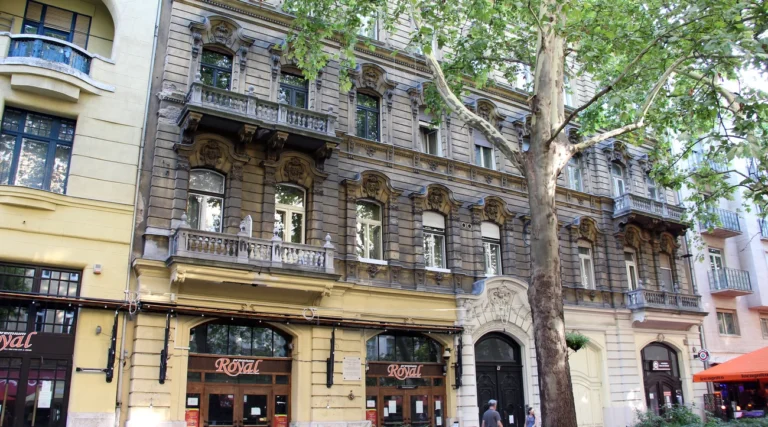
Look for the contrast between rounded corners, projecting window bays and long bands of balconies. The buildings make most sense together: one façade frames the park, the next turns the corner towards a side street. Instead of photographing only a doorway, step back on the pavement and compare the whole block.
At Szent István Park 10, Budapest 100 identifies a 1933 apartment building designed by Gyula Jakobik. Its relationship with neighbouring Pozsonyi út 36 is a useful small detail to seek out on a walk. This is a precise place to begin looking, rather than a reason to label every building in the neighbourhood with the same architectural style.
Make the park the pause, rather than the finish line
Szent István Park has two parts separated by Pozsonyi út. Cross the road deliberately instead of assuming the green space is one uninterrupted garden. Use a bench or a short stroll to break the walk, especially if you have already spent the morning among the major central sights.
Families and local residents use the space for ordinary recreation. Leave room for that everyday life when taking photographs. Follow the entrance signs for access arrangements; the park’s name on a map should not be read as a promise that every part is accessible at every hour.
Choose a café by the kind of stop you want
A quick coffee at the counter and a long lunch are different pauses. Read the menu before sitting down, check whether the table is for service and compare the total you expect to pay, including any stated service charge. There is no need to choose the busiest frontage simply because it appears first on your route.
For a short visit, make one café stop part of the plan and leave the next stretch flexible. If you want to browse shop windows or spend time with a book, build the afternoon around that slower pace. The neighbourhood works best when you are willing to stop walking for a while.
Keep the river and Margaret Island as optional extensions
The Danube gives the walk a change of scale after the apartment streets and park. Choose an appropriate signed pedestrian route and crossings; riverfront roads should not be treated as a continuous traffic-free promenade. Wind and weather can make a riverside pause feel very different from a sheltered street.
Margaret Island can be a separate extension if you have the time and energy. It is a larger outing with its own paths and attractions. Decide whether you want a neighbourhood afternoon or an island walk before trying to combine both, and use the dedicated Margaret Island guide for that part of the day.
- Do not enter residential staircases without an invitation.
- Do not confuse Újlipótváros with the older centre farther south.
- Check a café’s full menu and any service charge.
- Do not assume a city-highlights tour includes this area.
- Start from the part of the neighbourhood nearest your arrival.
- Allow time to stop instead of scheduling only walking.
- Keep the island extension optional.
- Check the actual street when choosing accommodation.
Arriving from Jászai Mari tér or the Szent István Park trolleybus stop
Jászai Mari tér is a useful southern starting point, served by trams 4 and 6. BKK’s line 76 route also includes Szent István park and Radnóti Miklós utca before its Jászai Mari tér terminus in that direction. Choose the stop that fits your starting point, and check BudapestGO for current service and accessible travel.
Staying here: compare the exact street and your daily journeys
A neighbourhood you enjoy for a café stop does not automatically suit every itinerary as a hotel base. Compare the actual address, entrance and connections to your planned visits. Check street-facing versus courtyard-facing rooms and the property’s own information about lifts, air conditioning and late arrival.
When comparing this area with the older centre, look at the journeys you will repeat, not only the straight-line distance on a map. The Central Pest accommodation guide covers a different area farther south; use it as a comparison rather than assuming that Lipótváros and Újlipótváros are interchangeable names.
From industrial ground to apartment streets
The streets around Szent István Park were shaped by the transition from industrial land to a planned residential neighbourhood. Budapest 100 traces the park to a former parquet-factory site and a 1928 decision by the city’s public works council. That history makes the orderly blocks around the green space more than a decorative backdrop.
Apartment development in the early twentieth century brought a new scale and rhythm to the district. The houses around the park show how an individual building could also contribute to a coordinated streetscape: corners, rooflines and the relation to the open green space all matter.
The area’s history also includes persecution during the Holocaust. Budapest 100’s research on Szent István Park 10 documents Jewish residents and the building manager’s role during this period. Treat memorials and residential history with care, and distinguish the history of a specific house from a simplified story about the whole district.
City passes and guided walks for the wider Budapest trip
Újlipótváros: questions for a slower neighbourhood visit