Újbuda is best explored one neighbourhood at a time. Follow Bartók Béla Boulevard from Szent Gellért tér towards Móricz Zsigmond körtér, with a gallery or café pause. Feneketlen Lake makes a greener finish; Kopaszi-gát is a separate extension.
Start with Bartók Béla Boulevard, not the whole district
Újbuda is a large district; the Bartók area is a manageable introduction. Choose Szent Gellért tér for a start beside the Danube and work inland along the boulevard. Móricz Zsigmond körtér makes a natural point to review the rest of the day: stop for food, continue towards Feneketlen Lake, or use public transport for a different part of the district.
This is a neighbourhood walk rather than an admission route. You do not need to arrange a ticket simply to explore the public streets. A gallery programme, performance or other indoor visit has its own arrangements. Leave room for an unexpected stop instead of booking activities so tightly that the walk becomes a transfer between them.
- The public boulevard walk needs no attraction ticket.
- M4 offers a choice of starting stations along the route.
- A gallery programme and a café pause give the area its pace.
- District XI extends well beyond the Bartók area.
- Gallery and performance hours are separate from the street walk.
- Gellért Baths is closed for renovation.
Six places to shape your Újbuda visit
The boulevard gives the walk its spine. Choose the lake or the bay as an extension rather than trying to visit every part of District XI in one outing.
Small galleries give the boulevard its rhythm
The Bartók area has a cultural identity beyond its cafés. B32 Galéria és Kultúrtér, at Bartók Béla út 32, combines visual art with theatre and music programming. It is useful to look at the programme before the walk: an evening performance may change when you want to arrive, while an exhibition can become a shorter daytime stop.
Treat each cultural venue as a place with its own door and schedule. A district programme listing does not mean that every room is open throughout the day, or that every event is free. Choose one interior you actually want to see, then leave the surrounding street walk flexible. A closed gallery need not end the outing; the neighbourhood still has its public squares and cafés.
Put a café stop into the walk
A seated break is part of the appeal here. Decide whether you want a quick coffee, a proper lunch or an evening table before choosing somewhere. The same street can support very different outings: a short walk with a drink, a slow lunch followed by a gallery, or a performance with dinner nearby.
Compare the menu at the venue you choose, including any stated service charge. A terrace table and an indoor table can also feel very different beside a busy road. If conversation is the priority, look at the actual seating rather than choosing only from a photograph of the façade. No restaurant reservation or price is implied by this suggested walk.
Feneketlen Lake is an alternative finish
For a greener ending, use the separate Feneketlen Lake guide to plan a park detour. This works best as a change of pace after the boulevard. Keep the lake as the main final stop rather than treating it as one item in a long circuit through every part of southern Buda.
With limited time, choose between the lake and the river extension below. A neighbourhood visit becomes more enjoyable when there is room to sit down. If you are travelling with children or someone who needs regular rests, make that pause part of the plan before adding another landmark.
- Do not book Gellért admission: the bath is closed.
- Do not treat Kopaszi-gát as the next door to a Bartók café.
- Check the gallery programme before making a specific interior the purpose of the visit.
- Start at Szent Gellért tér and walk inland along Bartók Béla Boulevard.
- Pause around B32 or continue towards Móricz Zsigmond körtér.
- Choose Feneketlen Lake for a green finish; keep the bay as an alternative.
Choose the station for the first stop
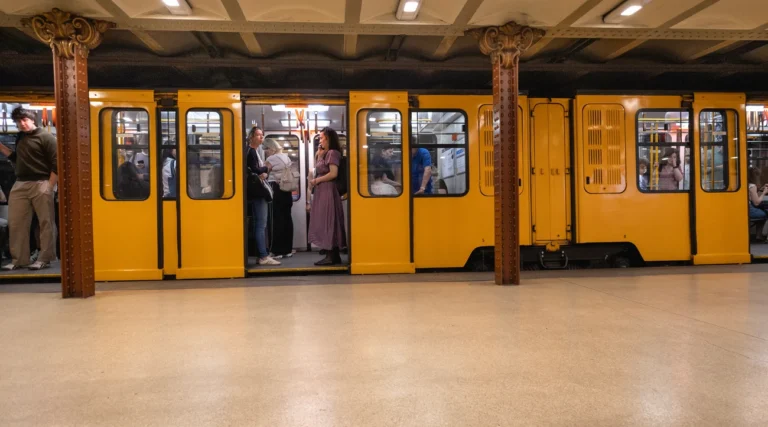
M4 serves Szent Gellért tér, Móricz Zsigmond körtér and Újbuda-központ. Choose the station closest to your first destination, and check current services and the final walk. Kelenföld is a separate transport choice, not another name for the short Bartók Boulevard walk.
Gellért Baths is closed for renovation. Do not build this outing around a swim there or confuse a view of the building with access to the baths. If bathing is essential, plan a separate visit to an operating bath and check the age, session and admission rules of that venue.
Kopaszi-gát needs its own part of the afternoon
Kopaszi-gát offers a different waterside outing, covered in its own guide. Do not read the district name as a promise that all its stops are beside one another. Check the full journey from your café or gallery before continuing to the bay.
If the water is your main reason for visiting southern Buda, reverse the priorities: plan the riverside walk first and add the boulevard only if you still have time. A lake pause, a bay walk and a cultural evening are three possible versions of the visit, not three compulsory stages.
From a transport corridor to a cultural boulevard
Trams have run along Bartók Béla Boulevard since 1898. The street developed as a link between southern Buda and the centre, while writers and artists such as Kosztolányi, Ottlik and Csontváry gave the area another identity beyond transport.
Before the 1920s the road appeared as Fehérvári út; it later bore Horthy Miklós’s name before receiving Bartók Béla’s in 1945. Its name records a political change as well as a cultural association.
A major reconstruction in 2002 renewed the road, pavements and tram tracks, with work at Móricz Zsigmond körtér continuing into the following year. The present mix of cafés, galleries and everyday transport is therefore layered over a much older route. Look beyond the ground-floor businesses to see how the boulevard joins the river to the inland neighbourhood.
Plan a bath visit or a guided city walk
Újbuda: questions before exploring