Budapest’s buses fill the gaps between the metro, the hilltop sights and the river. Castle District routes can save an uphill approach, bus 26 serves Margaret Island and surface routes along Andrássy Avenue offer an alternative to M1. Match the stop and direction to your entrance rather than boarding by number alone.
- Ordinary city buses use BKK fares. A single ticket covers one uninterrupted ride, not a bus-to-metro transfer.
- Watch the boarding sign. Some lines or sections require you to enter at the front and show your ticket or pass.
- 100E has its own airport fare. Bus 200E uses ordinary city tickets and passes.
- For late journeys, check the night route. Its number, stop and connection can differ from the daytime service.
Bus routes that help a visitor
Choose a route for a specific part of the visit. The table gives useful starting points, not a promise that every departure uses the same stops. Check current service, the direction shown on the vehicle and the walk from the stop in BudapestGO.
Castle Hill, an island entrance and a city-centre interchange are different arrival points. Leave time for the walk after getting off, and check the return stop separately: it may be across the street or around another corner.
Find the right stop and direction
The stop name and destination matter as much as the bus number. Read the timetable for your direction, check any service notice and make sure the boarding point is the one shown for your departure. A replacement bus or temporary diversion may use a different stop.
Choose a fare for one ride or several connections
A single bus ride and a journey with changes need different tickets. An ordinary single ticket does not cover a second bus, tram or metro ride. Compare a 30- or 90-minute digital ticket when your route has connections, or a travelcard for repeated journeys during its validity.
These are standard adult BKK fares in Hungarian forints. Buy ahead in BudapestGO or at a ticket machine. Where a marked driver-sale service is available, the on-the-spot single costs more. Bank-card purchases are offered on selected bus lines, including 105, 210, 210B and 200E; do not assume you can simply tap a card on every city bus.
- Paper single: validate it immediately after boarding and keep it for inspection.
- Digital single or timed ticket: use the app’s validation process for the journey. At a front-door boarding service, show the moving image to the driver.
- Travelcard or pass: follow that product’s display instructions; it is not a fresh single ticket to stamp on each ride.
- A single ticket does not allow a return trip or a break followed by another boarding.
- With a 30- or 90-minute ticket, validate again when changing to another surface vehicle within the time window.
- Keep your phone working and the purchased product ready before boarding.
- Ordinary city travelcards exclude the separate-fare 100E Airport Express.
Board, validate and signal your stop
Follow the sign on your actual service. “Front-door boarding only” means you enter by the driver for the ticket or pass check. The rule can depend on the section and time of day, so do not copy the boarding pattern of a different bus at the same stop.
- Confirm the service. Match the number, destination and current stop to your planned route.
- Board through the permitted door. Show your valid fare product when required and validate a paper single immediately.
- Prepare to get off. Watch the next-stop information and press the stop-request button in time.
- Keep proof of travel. Retain the ticket or app product for inspection; ordinary BKK buses do not use a citywide tap-in/tap-out bank-card system.
Buying a paper ticket is not the same as validating it. Resolve a ticket or app problem before travelling rather than waiting for an inspection. If you need to buy from the driver, check that the vehicle offers ticket sales and the accepted payment method.
Airport buses: separate the 100E and 200E fares
100E Airport Express uses a dedicated 2,500 HUF (≈ €6.84) airport ticket. It connects the terminal with central Pest, including Kálvin tér and Deák Ferenc tér. An ordinary single ticket or 24-hour travelcard does not replace that fare.
200E uses ordinary BKK fares. During metro hours, change at Kőbánya-Kispest for M3; one ordinary single on 200E does not also cover the metro. Both airport buses operate around the clock, but the onward night connection for 200E differs from the daytime metro journey. Plan for the time you will actually leave the terminal.
Night buses: plan the return from your actual stop
Use the night network after daytime services finish. Regular BKK fares apply, and night buses are not automatically a continuation of the daytime route with the same number. Look up the full journey, including the interchange and the final walk to your accommodation.
Check the stop and departure after a dinner, concert or cruise, particularly if your evening ends at a river dock. Front-door checks apply on many night routes or sections. The usual overnight tram 6 corridor on the Grand Boulevard can have a 4–6 replacement bus during maintenance; check the actual night and roadside boarding point. It does not replace a connection to every neighbourhood.
Low-floor vehicles and the final approach
Check the actual low-floor departure and boarding point. BudapestGO and BKK service information help identify suitable vehicles and disruptions. A low-floor bus does not settle every part of the journey: the kerb, waiting space and the route from the stop still matter.
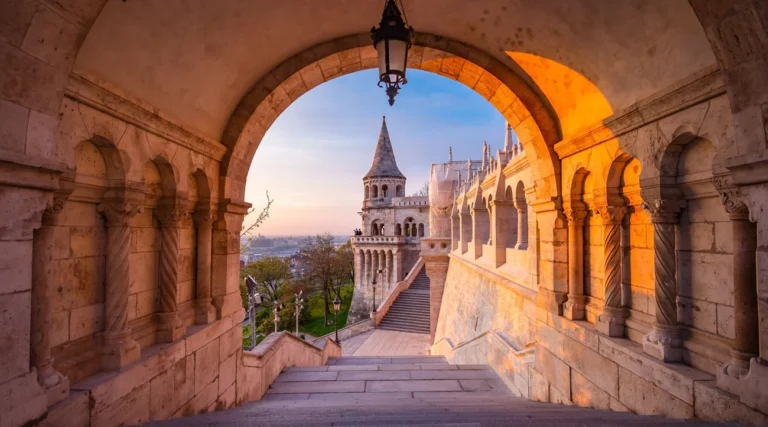
For Castle Hill, check gradients and the precise attraction entrance after getting off. With a wheelchair, mobility aid or pushchair, allow for boarding space and ask for assistance where needed. Do not treat a route number alone as a guarantee of a barrier-free door-to-door journey.
When a walk, tram or metro makes more sense
Use the mode that fits the distance and the day. A short Pest walk can be simpler than finding another stop; the metro can avoid road traffic on a longer connection. Public buses are transport services. A narrated hop-on sightseeing tour has its own ticket, stops and inclusions.
From Andrássy Avenue to a citywide bus network
Scheduled bus transport began in Budapest on 1 March 1915. The first service ran along Andrássy Avenue, adding motor buses to a city already served by other forms of public transport. The early fleet included both battery-electric and petrol-powered vehicles.
A double-decker battery-powered Austro-Daimler and a single-decker petrol vehicle entered service at the beginning of that first scheduled operation. The mixture is a reminder that electric bus propulsion is not a wholly new idea in Budapest’s transport story.
The network developed far beyond that early avenue route. For a visitor today, its value is practical: surface journeys, hill approaches and connections to places that are not beside a metro platform. Historic context does not change the current ticket or boarding rules.
Book the outing separately from the bus journey
A city bus fare pays for transport, not attraction admission or a guided tour. Compare the Budapest Card’s actual benefits if you want a visitor pass, or choose a Castle District walking tour for a guided outing. Check each product’s meeting point and inclusions separately from your BKK journey.
Frequently asked questions