Danubius Fountain is a small but rewarding art stop on Erzsébet Square. Give the stone figures a few minutes rather than walking past on the way from Deák Ferenc tér. The fountain represents four rivers, with Danubius above the lower figures and basins.
- It is a free outdoor sculpture stop in central Pest.
- Look at the group from more than one side.
- Combine it with the Basilica or Vörösmarty Square instead of making a special cross-city journey.
Find Danubius on Erzsébet Square, not beside the river
The name refers to the Danube, but the fountain stands inland on Erzsébet tér. Use the square as your destination, near Deák Ferenc tér, rather than navigating to the riverbank. It works as a pause within a central Pest walking day, not a visit that needs a fixed admission slot.
Four rivers in one stone composition
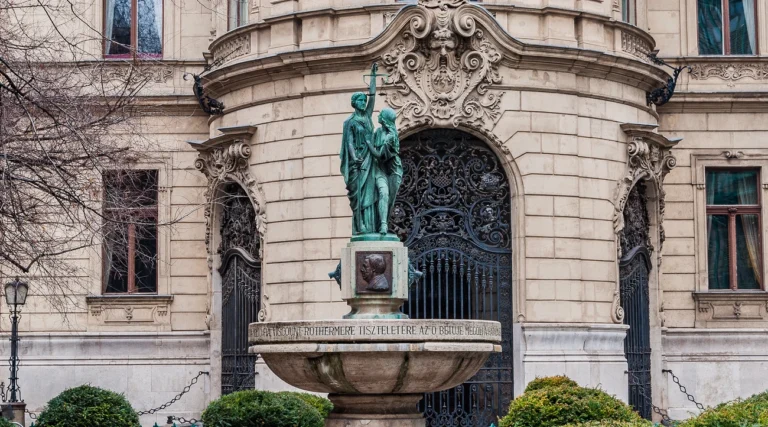
Start with the upper figure, then read the lower group. Danubius personifies the Danube; the three women represent the Tisza, Dráva and Száva. The figures turn a group of rivers into a sculptural scene rather than a literal map.
Step back for the basins, then look at the figures
Take one wider view before concentrating on details. The tiered basins explain the vertical shape; closer views reveal faces, shells and the modelling of the seated figures. Move around without climbing the stonework or blocking people crossing the square.
A sculpture stop rather than a timed water show
Come for the sculpture, not for a scheduled musical performance. Danubius is a different attraction from Margaret Island’s Musical Fountain. Water operation can change with weather and maintenance; the carved composition remains the reason for the stop even when no water is running.
Build a short central Pest walk around the fountain
Use Erzsébet Square as the hinge between a few nearby stops. Choose the Basilica side for a church-and-café outing or continue towards Vörösmarty Square for another public-space stop. You do not need to combine both with a long river circuit.
- The public sculpture itself has no admission ticket.
- Do not confuse Erzsébet tér with the Danube embankment.
- Water in a photograph is not a promise of operation during your visit.
- Nearby attractions and cafés have their own terms and prices.
- Allow roughly 10–15 minutes for a relaxed look; this is a planning estimate.
- Take a whole-group view and a closer detail rather than climbing for a photograph.
- Keep the pause flexible within your walking route.
- Use the current surface conditions and crossings to choose your approach.
Reach Erzsébet Square from Deák Ferenc tér
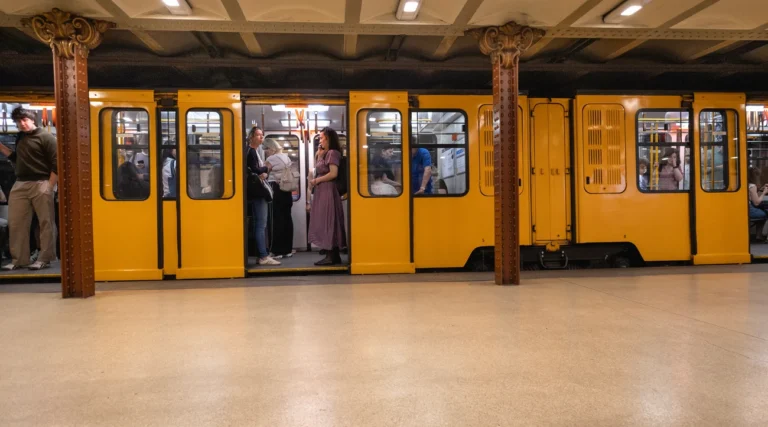
Deák Ferenc tér is the practical public-transport reference for this stop. From the station area, walk onto Erzsébet Square and look for the tiered stone fountain. Follow the pedestrian routes and crossings rather than aiming for the nearest point on the road.
Keep the free fountain separate from nearby paid visits
Seeing the fountain does not include admission to anything nearby. A Basilica interior or terrace ticket and a guided Pest walk are separate choices. If you want a tour to discuss this particular sculpture, check that its advertised route names it; do not infer an inclusion from “city walk” alone.
From Kálvin Square to a new home in central Pest
The fountain was made for Kálvin Square and opened to the public in 1883. Miklós Ybl designed the architectural composition; Leó Fessler modelled the figures. Its present setting is part of a later chapter rather than its original address.
The stone figures were carved by Béla Brestyánszky, while the wider project involved János Kauser and Vilmos Marchenke. The fountain was badly damaged in the Second World War. After restoration and reconstruction, it was re-erected on Erzsébet Square in the 1950s under sculptor Dezső Győri’s direction.
Later conservation campaigns renewed the stonework and details. The work you see is therefore a surviving and restored city monument, not an untouched group that has always stood in this square.
Basilica admission and guided walks for a wider visit
Danubius Fountain: practical questions