Choose where to leave the car before choosing the first attraction. A hotel garage may suit an overnight stay; P+R can work for a day continued by metro; a street space is a different decision with its own charge and time limit. Compare the complete outing, including the journey back, rather than the lowest headline parking price.
Street, garage or P+R: choose for the whole visit
The convenient parking choice depends on how you will use the car. For a short stop, look for a legal space close enough to complete the errand and return comfortably. For several hours of sightseeing, compare a garage with a P+R connection. For an overnight stay, ask your accommodation about its actual parking arrangements before setting off.
A cheap space far from the end of your day can become an awkward choice when you are tired, carrying luggage or travelling with children. Work backwards from your likely finish: where will you be after dinner, how will you reach the car, and do you need it again that evening?
Do not treat a map pin as an arrival plan. Save the vehicle entrance rather than only the building address, read any height or access restrictions, and have a second option in mind. The last few minutes on an unfamiliar street are easier when you have already decided where you are trying to enter.
Keep parking and sightseeing as two separate decisions. Once the car is left legally, build the visit around a walk or public transport connection. Moving the car between every central stop adds another search and another parking decision to the day.
Street parking zones: hourly fees and time limits
BKK currently lists four street-parking zones. For passenger cars, hourly charges are A: 800 HUF (≈ €2.20), B: 600 HUF (≈ €1.65), C: 400 HUF (≈ €1.10), D: 300 HUF (≈ €0.80). Standard working-day periods are A 08:00–22:00, B 08:00–20:00 and C/D 08:00–18:00. Local start times can differ. A–C have a three-hour limit; D has no zone time limit.
Read the sign beside the actual space. A zone letter is not permission to use every bay on the street; residents-only and other restrictions still matter. These are public-street rules, not a price list for private garages.
Euro amounts are rounded illustrations, using about 365 HUF to €1. Payment is in forints; your card or service provider can produce a different euro cost.
Paying for street parking with a foreign phone
Prepare a suitable parking app before arrival. BKK’s current instructions replace street meters with app, SMS or telephone payment; it recommends an app for visitors without a Hungarian mobile subscription. Check the zone, registration details and successful session confirmation before walking away.
Give this task its own moment. Unload what you need, stand somewhere safe and read the confirmation instead of trying to organise a route, bags and payment at the same time. Keep enough phone charge for the return and save the street name separately from your sightseeing itinerary.
An app screen, a bank notification and the parking session are different things to check. If the result is unclear, resolve it before leaving the car rather than assuming that entering card details has completed the process. Use the instructions of the particular service you selected.
Etele P2: a worked example beside metro M4
Etele P2 is a paid P+R beside the Kelenföld end of metro M4. Budapest Közút lists 24-hour opening, 221 car spaces and five accessible spaces. Its daytime charge is 500 HUF (≈ €1.40) per occasion between 06:00 and 22:00; between 22:00 and 06:00 it charges 300 HUF (≈ €0.80) per hour.
The operator lists cash or bank-card payment at its machines before exit, with Parkl ticketless parking also available. This facility therefore has its own payment arrangements, distinct from on-street parking. A pass does not guarantee a space, and the operator does not offer space reservations.
A day visit and an overnight stop do not have the same cost. For example, an uninterrupted 22:00–06:00 stay involves eight hourly night charges: 2,400 HUF (≈ €6.60), before any applicable daytime charge. Budget for public transport separately and choose the metro connection that suits your destination.
Overnight parking starts with your accommodation
Ask your hotel or apartment host exactly what “parking available” means. Is the space in the building, in a partner garage or simply somewhere nearby? Ask how to enter, whether a place is reserved, what vehicle fits and whether you can take the car out and return under the quoted price.
For a central stay, compare that answer with the effort of returning to a more distant car park. The lowest parking charge is not necessarily the best overall choice when you have bags, an early departure or several passengers. Put the accommodation and parking totals beside each other before deciding.
Street parking also needs a plan for the following morning. Do not assume a bay is available to visitors simply because you arrive outside the normal charging period. Residents-only signs can impose evening and overnight restrictions. If you are unsure about a particular bay, choose a clearly suitable alternative.
- Street parking, garages and P+R have separate conditions.
- A parking payment does not include your metro journey.
- Use the exact entrance and keep a return route.
- Confirm overnight arrangements with your accommodation.
- Read the signs at the actual bay.
- Compare the total visit, including transport and late collection.
Plan the return journey before leaving the car
Save the way back before starting the outing. Photograph the row or level, note the pedestrian entrance and keep any ticket or confirmation accessible. If members of your group may return separately, make sure each person understands the meeting point.
For P+R, check the return connection rather than only the outward metro ride. A long dinner or evening show can change the practical choice of route. Leave enough time to collect the car without rushing, and keep the final walk from the station in the plan.
If you decide to stay out longer, reassess the parking conditions as well as the transport. A flexible sightseeing day works best when it does not depend on an assumption about a closing time, a street restriction or an unconfirmed parking session.
Why Budapest connects parking with public transport
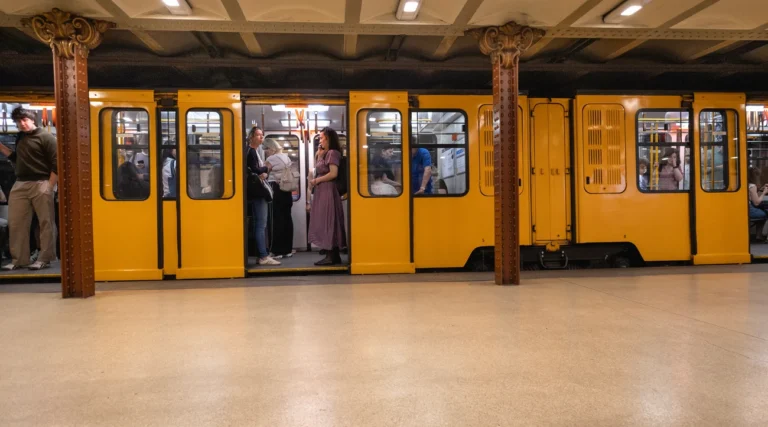
P+R is part of Budapest’s approach to reducing pressure on central streets. It lets a driver finish the longer road journey at a transport connection and continue through the city without repeatedly searching for another space.
BKK describes its P+R network as a way to connect car travel with public transport and reduce traffic in the inner districts. Kelenföld, at the end of M4, is one of the major interchange areas in that network; other facilities connect with different metro and suburban routes.
That background explains the practical distinction. A P+R is a starting point for the rest of the journey, rather than a promise of a central parking space beside every attraction. Choose the connection for the part of Budapest you want to visit, then check the individual facility’s current terms.
Continue around Budapest without driving between sights
Questions about parking in Budapest