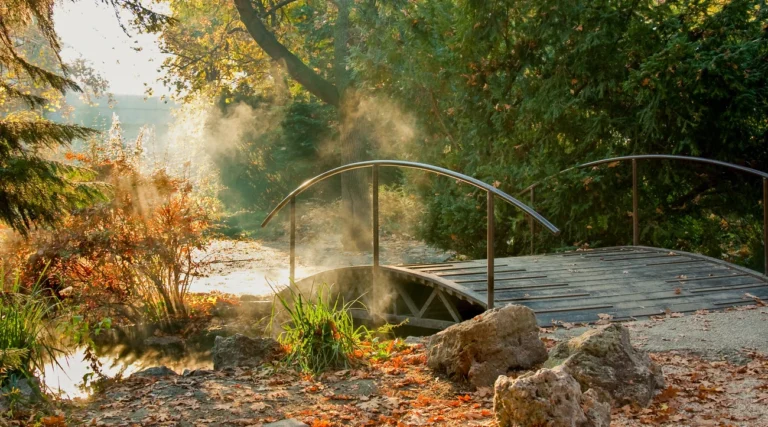
Károlyi Garden rewards a slower kind of sightseeing. A few streets back from the traffic around Astoria and Kálvin tér, this small enclosed park offers trees, benches and details you can miss if you only cross it on the way somewhere else. It works best as a pause within a central Pest day.
Make a gentle circuit, look for the rabbit sculpture and leave time to sit down. The neighbouring Károlyi Palace gives the garden a historical setting, while the playground makes it an everyday family space too. Expect a lived-in city garden, with children playing and people taking a break, rather than guaranteed silence.
Seasonal gate hours: plan a daytime garden stop
The public garden is free, but its gates have seasonal closing times. The district community institution publishes an 08:00 opening throughout the year, with closing between 17:00 in winter and 21:00 in summer. The schedule below concerns the park; museum exhibitions and organised events have separate arrangements.
Check the notice at the entrance when you arrive, particularly around maintenance or exceptional closures. A daytime visit is the simplest plan. Do not treat the park as an overnight shortcut between surrounding streets.
Walk the paths before choosing your bench
This is a garden to explore at close range. Follow the paths around the planted areas, notice the surrounding façades and choose a place to sit according to the light and activity around you. A single bench stop can be more satisfying here than turning the visit into a long route.
Allow around 20–40 minutes for a short visit, with longer if you want to read or give children time to play. It is easy to combine with nearby streets, but it does not offer the extensive paths of Margaret Island or the hills of Normafa.
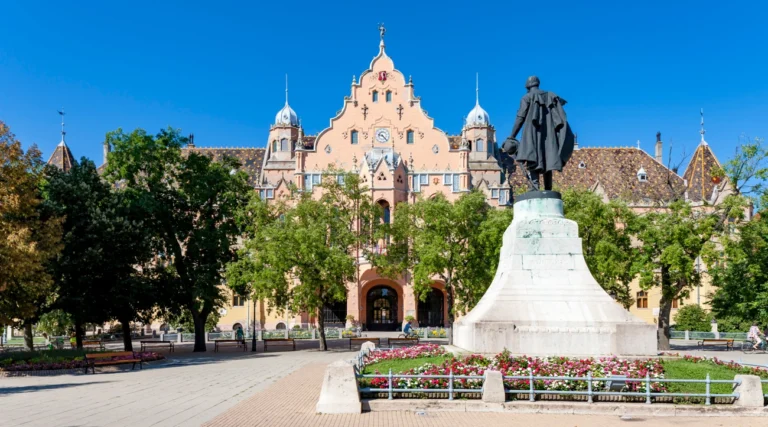
Main photograph: Czimmy / Wikimedia Commons, CC BY-SA 3.0. Photographed in 2013; cropped, resized and converted to WebP. The adapted image uses the same license.
Károly the rabbit and the garden’s human figures
The small bronze Károly rabbit is one of the garden’s most approachable details. Sculptor Géza Dezső Fekete’s work was unveiled in 2016 to remember a real rabbit that had lived here. It is a memorial sculpture, so there is no live-animal encounter to book or promise.
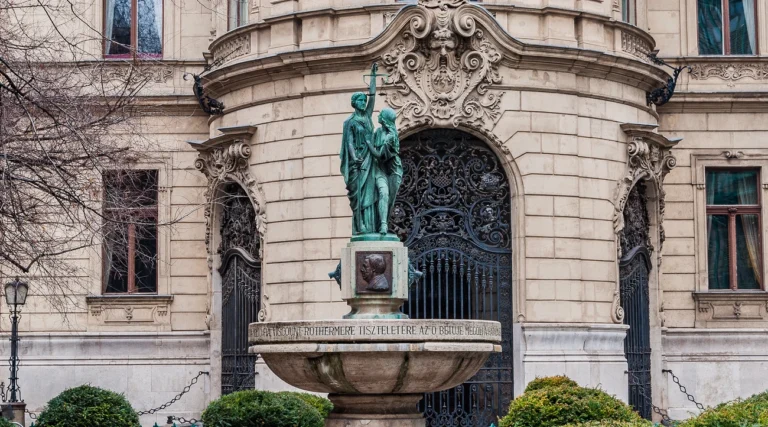
The garden also has a monument to the politician Dániel Irányi and a sculpture of composer László Lajtha. Look at their different forms rather than expecting one uniform sculpture trail. Keep children beside the paths and treat the works as public art, not climbing equipment.
A playground pause without turning the day into a race
The playground gives a family visit a different rhythm. Put the break between two nearby activities rather than after everyone is exhausted. One adult can check the entrance notice and the next part of the route while the children settle into play.
Bring water and keep an eye on the time remaining before the gates close. The garden is compact, so running, play and quiet reading share a relatively small space. Choose a bench away from the busiest play area if a calmer pause matters to you, and use the posted rules for play areas and lawns.
Garden, palace and museum: separate the visits
The garden was once part of the Károlyi Palace estate. The palace now houses the Petőfi Literary Museum. That connection gives a short park visit more context, but walking into the public garden is different from visiting an exhibition or joining a museum programme.
The museum has described the renewed connection between its courtyard and the garden. For your actual route, follow the entrances open on the day; do not rely on an indoor passage as a permanent shortcut. If visiting with a wheelchair or pram, confirm the complete approach and any museum access separately rather than assuming every entrance has identical conditions.
- The garden opens at 08:00 on the published seasonal schedule.
- Winter closing is earlier than summer closing.
- The public park and museum exhibitions are separate visits.
- Károly is a bronze rabbit sculpture, not a booked animal encounter.
- Choose a daytime pause between nearby Pest sights.
- Allow extra time for the playground rather than rushing onward.
- Use paths and follow the posted garden rules.
- Check the gate notice before settling in for a long break.
Getting to Károlyi Garden from central Pest
Kálvin tér, Ferenciek tere and Astoria are useful starting points for the surrounding streets. Kálvin tér serves M3 and M4, Ferenciek tere M3, and Astoria M2. Choose the station that fits your wider journey rather than making an unnecessary change for a short final walk.
Approach the garden through the streets around the Károlyi Palace and use an open public gate. Confirm the actual entrance in your walking directions. The park is close to the Hungarian National Museum area, but leave time for street crossings instead of treating a map’s straight line as the route.
A garden pause, Hungarian cakes and a museum choice
Pair the garden with one nearby indoor stop. The Hungarian National Museum area suits a history-focused day, while Centrál on Károlyi utca gives you a different kind of interior and a cake or coffee break. Museum admission and café spending are separate from the free park visit.
Keep the order flexible around the garden’s closing time and any reservation. If the park is your rest stop, let it be one: a bench, a short look at the sculptures and an unhurried walk back into the streets can be enough. Our café guide compares Centrál with other classic Budapest choices.
From a private palace garden to an everyday public park
The garden’s palace setting is real, but its public life is a later chapter. The museum’s account describes an eighteenth-century garden in French taste, followed by an English-style landscape garden during Count György Károlyi’s rebuilding of the residence. The former greenhouse and gardener’s house no longer survive.
The garden became public in the late 1920s and early 1930s. Accounts use different milestones for that transition, so it is more useful to understand the change than to attach the whole process to one opening day: a private aristocratic space became part of ordinary city life.
The artworks arrived during that public chapter. Irányi’s monument moved here in 1948, while the Lajtha and rabbit sculptures are twenty-first-century additions. The mix makes the garden a small record of changing commemorations as well as a place to rest.
Compare passes and guided walks for your wider Budapest day
Károlyi Garden: practical questions