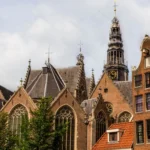
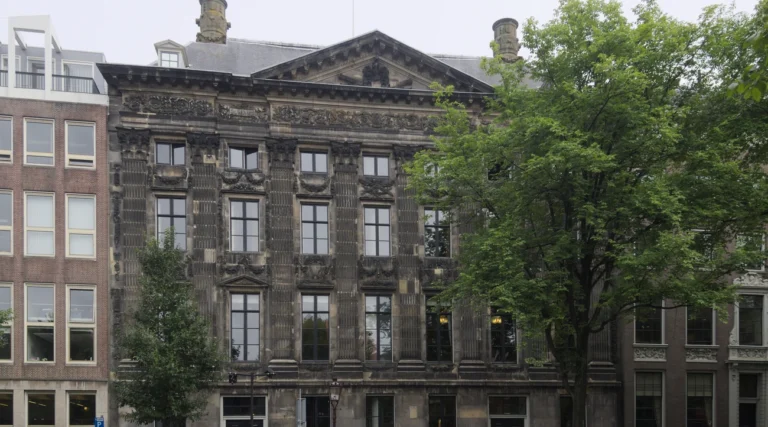
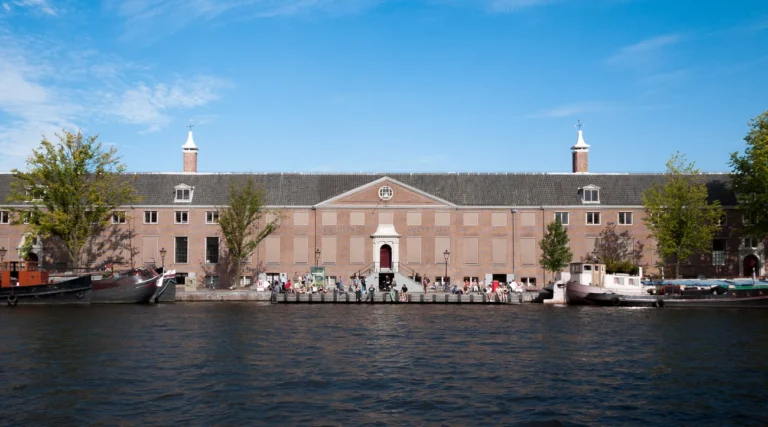
Behind a gateway on Oude Hoogstraat, Oost-Indisch Huis preserves the setting of the Amsterdam chamber of the Dutch East India Company, usually known as the VOC. Its enclosed courtyard connects an attractive piece of old Amsterdam with the administration of a far-reaching trading and colonial organisation.
The complex now serves the University of Amsterdam. Approach it as a historic exterior stop with access subject to the university’s arrangements, rather than a museum where a general ticket opens the former company rooms.
Oost-Indisch Huis access and university opening hours
The university lists building hours of Monday–Thursday, 08:00–20:00, and Friday, 08:00–19:30, with Saturday and Sunday closed. These are university operating hours, not a guarantee of tourist entry. Courtyard and interior access can be restricted; respect closed gates and ask reception if access is appropriate.
What to notice at the former VOC headquarters
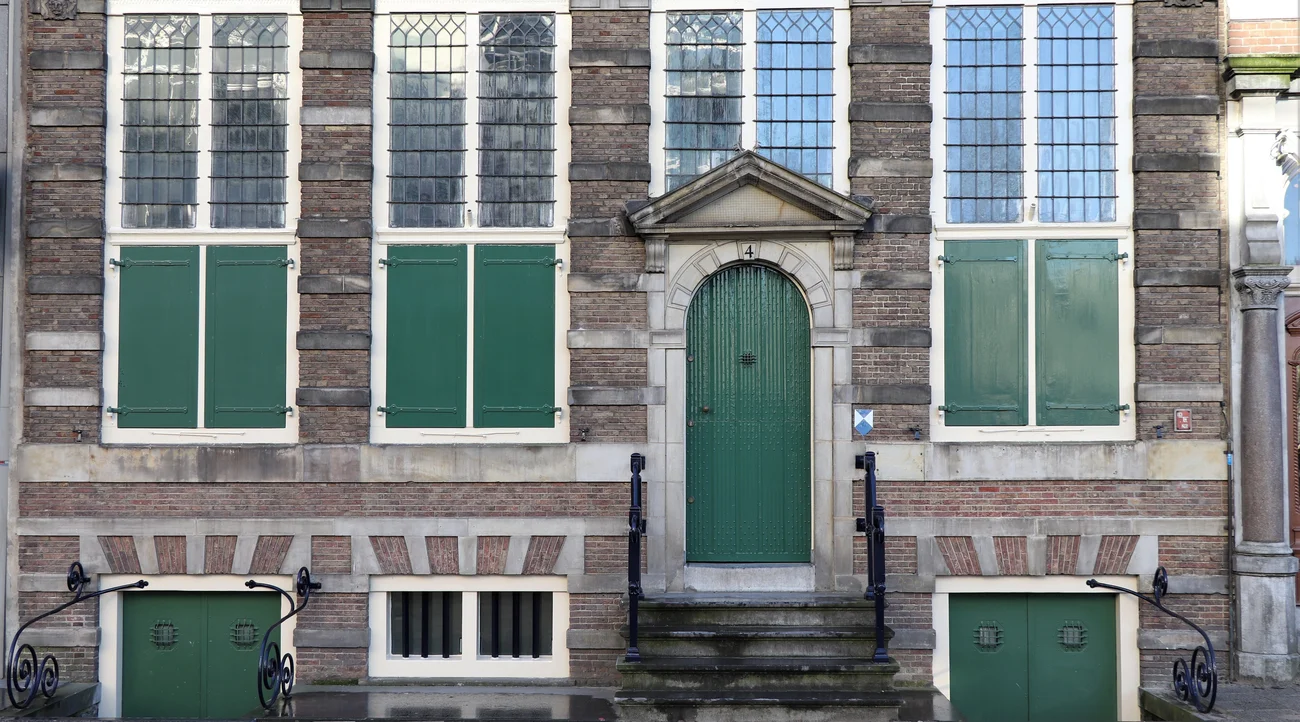
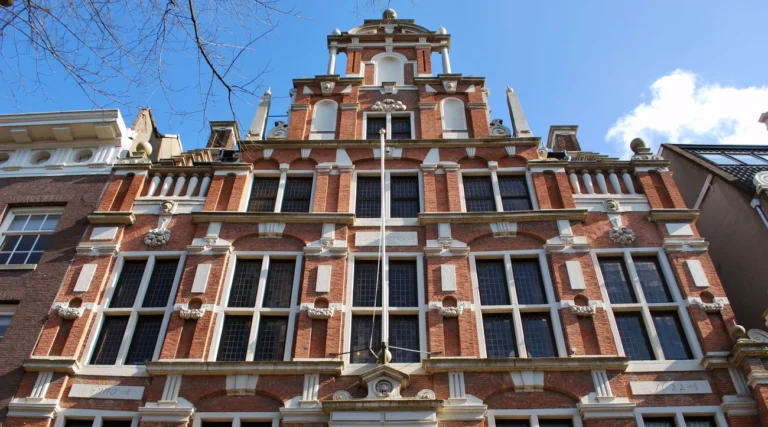
Look for the contrast between the narrow street entrance and the enclosed architecture behind it. If access is permitted, remain in the visitor area and notice the brickwork, pale stone details and repeated windows without entering teaching or office rooms.
Plan a respectful historic stop
An exterior look can fit into a short old-town walk. Treat any courtyard access as conditional and leave the university’s working spaces undisturbed. A guide can explain the VOC’s role without requiring access to the historic meeting rooms.
How to see Oost-Indisch Huis and understand its past
Allow approximately 15–25 minutes for the street setting and a permitted courtyard look, with a shorter stop if the gate is closed. Avoid building a tight itinerary around interior access that has not been arranged.
The optional guided walk below focuses on the Dutch East and West India Companies. Its published itinerary identifies the former VOC headquarters as a pass-by. It is a wider historical walk, not an admission ticket or a promise of entry to the courtyard, university rooms or former boardroom. Check the selected option and group-price conditions.
- This is a working university complex, not an independently ticketed museum.
- Operating hours do not establish a public tourist route.
- Respect gates, reception instructions, teaching and research.
- The VOC’s trading history includes colonial conquest, forced labour and violence.
- Look at the gateway from Oude Hoogstraat before deciding whether to approach reception.
- Keep voices low and do not photograph people working without their permission.
- Combine the stop with nearby Trippenhuis and Nieuwmarkt for a walk through different forms of merchant power.
- For a fuller museum visit, plan the National Maritime Museum separately; its ticket does not provide access here.
Getting to Oude Hoogstraat and the Bushuis
The historic address is Oude Hoogstraat 24, close to Kloveniersburgwal and Nieuwmarkt. The university lists the main entrance of the wider Bushuis complex at Kloveniersburgwal 48. Use the entrance appropriate to your arranged visit and follow current reception directions. Nieuwmarkt metro station is a convenient starting point.
The VOC’s administration and colonial power
The VOC was founded in 1602 by combining earlier trading companies. The East India House was completed in 1606 as one of its headquarters. Here, directors dealt with voyages, accounts, maps and instructions that connected Amsterdam with a vast overseas network.
Company administration was inseparable from colonial power. The VOC had authority to negotiate treaties, wage war and exercise justice. Decisions made in Amsterdam supported systems of conquest and coerced production overseas, not simply the peaceful exchange of spices.
In 1638, a banquet for Maria de’ Medici displayed the company’s global reach through food and products. The contrast between the wealth presented in Amsterdam and the conditions behind its production is central to understanding this site.
The complex is now used by the University of Amsterdam. Its present purpose is another reason to distinguish historical interpretation from visitor access: seeing the courtyard, when allowed, does not make its working rooms public galleries.
Reading the site beyond its courtyard
- Oost means east: this was associated with the Dutch East India Company, not the separate West India Company.
- The complex links the Oude Hoogstraat address with the Bushuis on Kloveniersburgwal.
- Administrative documents and maps were as important to the company’s operations as ships and warehouses.
- A quiet courtyard can carry a history of decisions with consequences far beyond the city.
Maritime history and guided old-town walks
Stay near Nieuwmarkt and the eastern old town
Accommodation around Nieuwmarkt, Kloveniersburgwal and the eastern old town makes this area easy to explore on foot. Check room noise, stairs and lift access in older properties. The map below is centred on Oost-Indisch Huis; confirm dates and the property’s exact location before booking.
Oost-Indisch Huis: frequently asked questions
More activities and experiences in Amsterdam