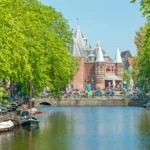
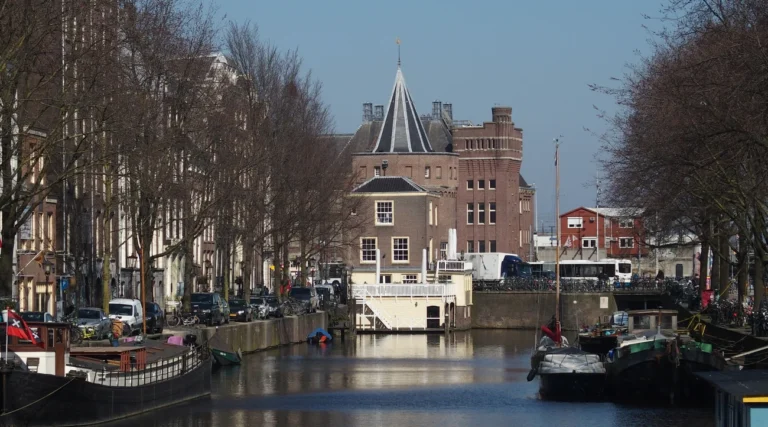
The Schreierstoren stands close to Amsterdam Centraal, beside the meeting of the Geldersekade and the old harbour edge. Its rounded brick exterior, steep roof and compact shape make it easy to distinguish from the much larger buildings around it. This was once part of a continuous defensive system, rather than an isolated picturesque tower.
It is also associated with one of Amsterdam’s best-known naming legends: the Tower of Tears. The story of women watching sailors depart is memorable, but the name is linked to a sharp corner in the city wall. A short exterior visit gives you both a surviving piece of medieval Amsterdam and a useful reminder to separate history from folklore.
Schreierstoren access and visiting information
Looking at the Schreierstoren from public streets is free. The building is not presented here as a public observation tower or a museum with a standard admission route. Any business, private room or event inside has its own arrangements; do not treat those as general access to the monument.
Details to notice at the harbour tower
Walk around the publicly accessible sides to compare the tower’s outward-facing curve with its city-facing side. Look above eye level for the roofline, traces of its defensive form and the ship-shaped weather vane. Use crossings carefully: the location is close to a busy station approach.
Planning your Schreierstoren stop
The Schreierstoren is an easy stop at the beginning or end of a historic-centre walk. It is most rewarding when you allow a little time to look at its form and imagine the former harbour, rather than treating it as a large indoor attraction.
How to visit the Schreierstoren
Allow around 15–25 minutes for the exterior, details and harbour-side context. Approach from Prins Hendrikkade, then look towards the Geldersekade to understand why this corner mattered. Viewing the building from public space is free.
The private historical walk and smartphone audio tour below list the Weeping Tower among their stops; the open-boat cruise lists Café the Schreiertower as a pass-by sight. The audio tour is self-guided, while the historical walk has a live guide. These optional activities do not include interior admission to the tower. Check the selected meeting point and itinerary before booking; boat routes may change.
- The exterior is free to view. Do not assume access to every room inside.
- The Tower of Tears story is a legend, not the accepted explanation of the tower’s name.
- Keep station approaches, entrances and narrow pavement sections clear.
- Check any current business or event arrangements separately if planning to enter.
- Compare the rounded and flatter sides rather than photographing only the roof.
- Look for the ship-shaped weather vane if visibility allows.
- Use the stop to begin a walk along Geldersekade towards Nieuwmarkt.
- Keep children close near traffic and open water; choose a safe place to pause.
Find the tower near Amsterdam Centraal
The tower stands at Prins Hendrikkade 94–95, southeast of Amsterdam Centraal. From the station, use the signed pedestrian crossings rather than taking a direct line through cycle traffic. The Geldersekade offers a walking connection into the old centre and towards Nieuwmarkt.
City walls, harbour history and a famous legend
The Schreierstoren belongs to Amsterdam’s late-fifteenth-century stone defences. The municipal archive dates it to 1487. Its outward-facing curved wall and flatter city side reflected a practical role at the edge of the fortified city, overlooking the harbour approaches.
The waterfront has changed considerably since then. What now looks like a small tower beside a busy street once stood in a very different relationship with the water, bridges and city wall. Reading it as a surviving fragment of a larger system makes more sense than imagining it was designed as a stand-alone attraction.
The building has been altered repeatedly. The national heritage register identifies later changes to its crown and spire, so the present silhouette should not be described as an entirely untouched medieval design. Its long life combines surviving defensive fabric with adaptation.
The popular story says that sailors’ wives wept here as ships left for uncertain voyages. The municipal explanation instead connects the original name Schreyhoekstoren with the sharp angle of the wall. A stone dated 1569, showing a woman and a departing ship, helped encourage the romantic interpretation. The maritime setting is real; the naming story needs that distinction.
A small part of the tower’s story even reaches Chicago. Stones associated with the Schreierstoren were incorporated into the Tribune Tower, whose collection brings together fragments from historic places. There they were labelled Tower of Tears, showing how the legend travelled beyond Amsterdam.
The Tower of Tears and other curiosities
- The ship-shaped weather vane recalls a cog, a vessel linked with Amsterdam’s historic city imagery.
- The name refers to a corner in the old wall; the crying-sailors’-wives explanation belongs to folklore.
- A 1569 wall stone helped keep the emotional version of the story alive.
- Stones from the Schreierstoren form part of the Tribune Tower’s historic-fragment collection in Chicago.
Hidden churches and walks through the old town
Stay near the old harbour
Staying near Prins Hendrikkade or Amsterdam Centraal can be practical for rail connections and walking into the old centre. Compare noise reviews and the route from the station, especially with luggage. The map below is centred on the Schreierstoren; accommodation prices and availability depend on the dates you choose.
Schreierstoren: practical questions
More activities and experiences in Amsterdam