The Homomonument brings LGBTQ+ remembrance into the everyday life of Amsterdam. Beside Westerkerk on Westermarkt, three pink granite triangles form a larger composition across the square and towards the Keizersgracht. You can walk past without immediately realising that the separate surfaces belong together.
Designed by Karin Daan and unveiled on 5 September 1987, it remembers people persecuted because of their sexual orientation. It is also a living place for solidarity, protest and celebration. Visit slowly, notice the different levels, and give space to anyone leaving flowers or remembering someone.
Homomonument access and opening information
The memorial is free to visit and open 24 hours a day, according to the Homomonument Foundation. It occupies public space rather than a gated attraction: there is no admission ticket or reserved entry slot. Events, maintenance or local restrictions can affect how you move around the square.
Read the memorial through its three triangles
Start by finding all three triangles. Their relationship to the paving, the canal and the surrounding city matters as much as the individual pieces of stone. Daylight makes the changes in height easier to see.
Plan a respectful visit to Westermarkt
Allow a short, thoughtful pause rather than treating the memorial only as a photograph. The following points help you plan a respectful visit within a walk around the western canal belt.
How to visit the Homomonument
Allow around 15–30 minutes to find the three elements, read the inscription and consider their setting. Begin on the square and keep the canal-side steps optional: you do not have to descend to appreciate the memorial. Take particular care beside the water and leave flowers or commemorative objects undisturbed.
For more context, the optional guided walks below list the Homomonument in their itinerary or meeting arrangements. Two focus on LGBTQ+ history; the cultural walk takes a broader view of the city and its people. These are paid guiding services, not admission tickets. Compare the actual route, guide language and meeting point for your date.
- Admission is free; a guided walk is optional.
- The lower triangle beside the water is reached by steps.
- Wheelchair users can visit the public square; account for traffic, paving and changing levels.
- Respect memorial gatherings and avoid obstructing other visitors.
- Find all three triangles before choosing a viewpoint.
- Read the inscription at ground level, then look towards the canal.
- Visit in daylight to see the pink granite and the different elevations.
- If booking a walk, use the meeting point on your confirmation rather than assuming every tour starts here.
Getting to Westermarkt
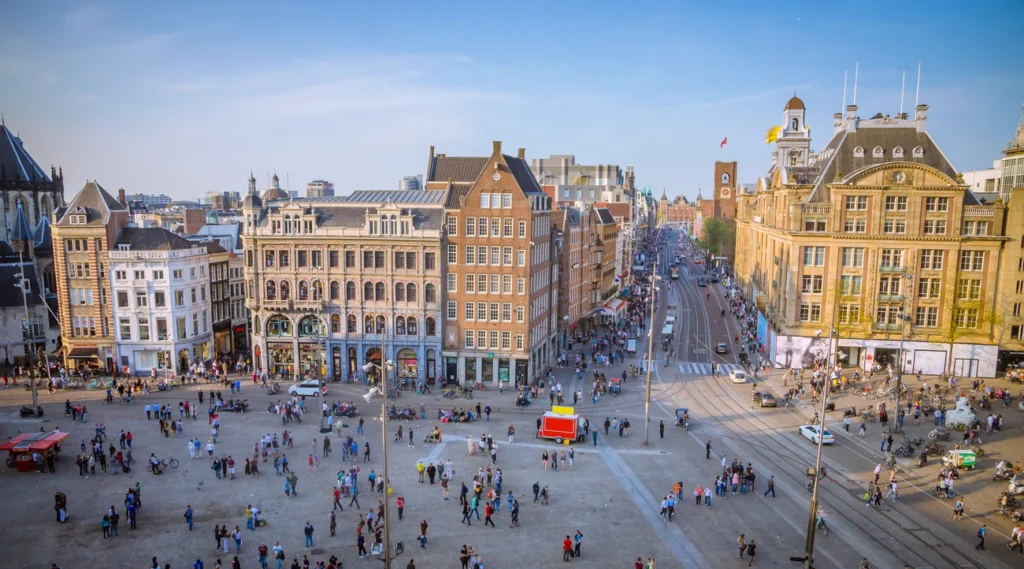
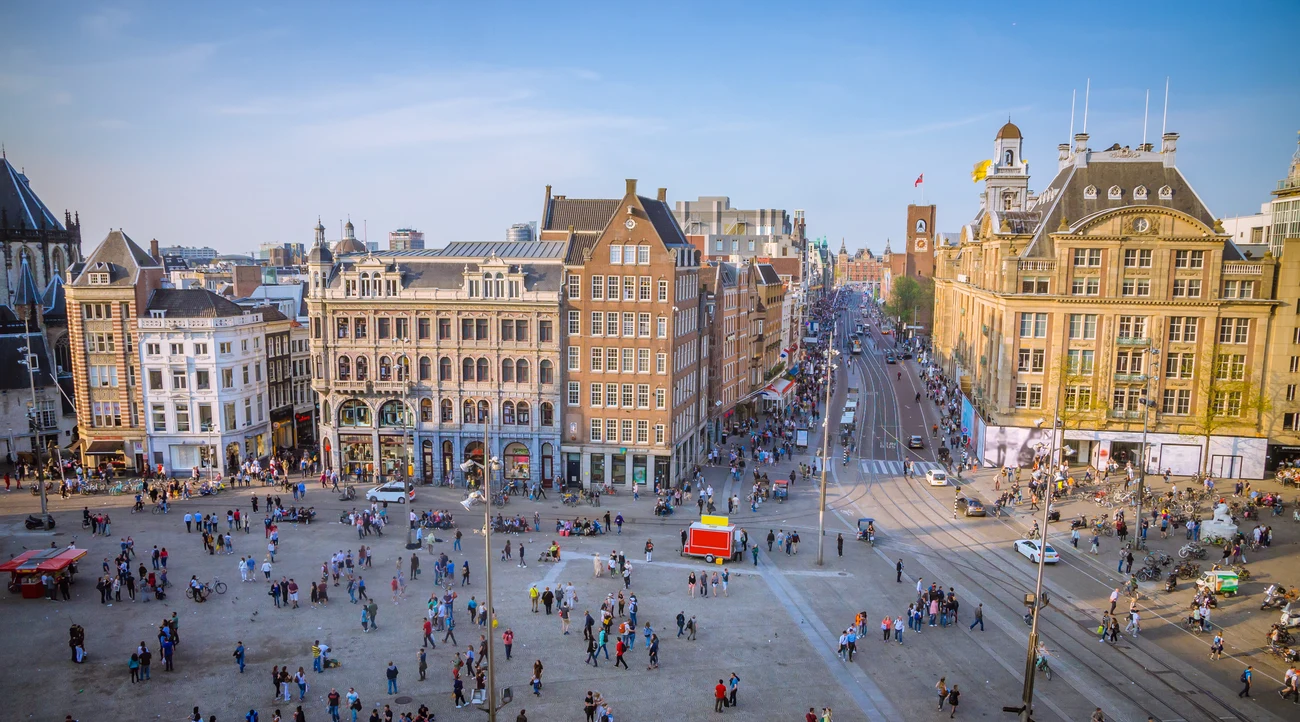
The Homomonument stands on Westermarkt beside Westerkerk, where the square meets the Keizersgracht. Westermarkt is the nearby tram stop. From Dam Square, follow Raadhuisstraat west towards the church; use marked crossings and keep clear of cycle routes.
From a demand for recognition to a living memorial
The memorial grew out of a struggle for recognition. The Foundation traces discussion of a monument within the COC to 1961. In 1970, two activists attempting to lay a wreath during the national commemoration on Dam Square were arrested, revealing how contested public remembrance remained.
A renewed call in 1979 led to a foundation and a location on Westermarkt. Karin Daan won the design competition held in 1980. Donations and public funding made construction possible, and the monument opened in September 1987.
Daan avoided a single upright statue. Instead, the design is woven into the square, with different elevations allowing remembrance to coexist with ordinary movement through the city. The pink triangle recalls the badge imposed on homosexual prisoners by the Nazi regime and its later reclamation as a symbol of visibility and resistance.
The Homomonument continues to host community remembrance, protests and celebrations. The Foundation describes annual commemorations on 4 May and around Transgender Day of Remembrance in November. An event calendar is separate from general access: check the current programme if attending a particular gathering is your reason for coming.
Details that give the monument its meaning
- The three smaller triangles together describe a larger triangle across the square.
- The poem line is by Jacob Israël de Haan.
- The design connects remembrance with the present and the possibility of change.
- Its everyday setting is intentional: this is a public place as well as a memorial.
Canal history and guided walks around central Amsterdam
Stay near Westermarkt and the western canal belt
Accommodation around Westermarkt, the western canal belt and the Jordaan makes it easy to explore on foot. Canal houses can have steep stairs, so check lift access and room arrangements when booking. Compare noise reviews and transport connections as well as the map distance. The map below is centred on the Homomonument; rates depend on your dates.
Homomonument: frequently asked questions
More activities and experiences in Amsterdam