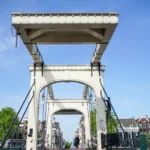
The Blauwbrug is one of the Amstel’s most richly decorated crossings. Ship-shaped piers, tall columns and crowned lanterns give this bridge a ceremonial character, even as it carries ordinary city traffic. It connects Amstelstraat with the Waterlooplein side of the river.
The bridge opened in 1883, designed by Bastiaan de Greef and Willem Springer. Its name, Blue Bridge, comes from a blue-painted predecessor. Visit for the architectural details and the views along the Amstel; crossing on the pedestrian pavements is free.
Blauwbrug access and crossing information
Blauwbrug is a public crossing, with no monument-admission ticket or attraction opening time. Use the pedestrian pavements and follow local traffic signals. Temporary street works or restrictions can affect the most convenient route across it.
Look closely at the bridge’s architecture
Give the decoration a closer look instead of treating the bridge only as a way to reach the opposite bank. The lantern columns are easy to notice from the pavement; the riverbank gives a better perspective on the piers and the three navigation openings.
Plan a short Blauwbrug visit
A short pause fits naturally into a walk between Rembrandtplein, Waterlooplein and the Amstel. Allow time to examine a few details, then continue along the river for a wider view of the crossing.
How to visit the Blauwbrug
Allow about 15–20 minutes for the bridge’s decoration and nearby river views. Stay on the pedestrian pavements and step aside where there is room if you want a photograph. A viewpoint on the bank is more suitable for studying the piers than stopping in the roadway.
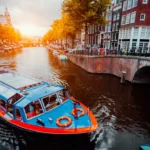
For a different perspective, the two cruises below list Blauwbrug in their published itineraries. The private photography lesson also includes the bridge among its listed shooting locations. These are optional activities, not bridge-admission tickets: walking across Blauwbrug is free. Boat routes and photography stops can change, so check your selected departure point and confirm the bridge visit with the operator if it is your priority.
- Blauwbrug is a fixed bridge with navigation passages beneath its deck.
- There is no admission charge for the public pedestrian crossing.
- The roadway carries city traffic; use the pedestrian pavements for looking at the decoration.
- Canal-cruise boarding points and routes depend on the selected operator and option.
- Look upwards for the crowns and paired lanterns.
- View the ship-shaped piers from a public riverside position.
- Combine the bridge with Waterlooplein and a walk along the Amstel.
- Allow more time at busy crossings and keep the pavement clear for other pedestrians.
Getting to the Waterlooplein crossing
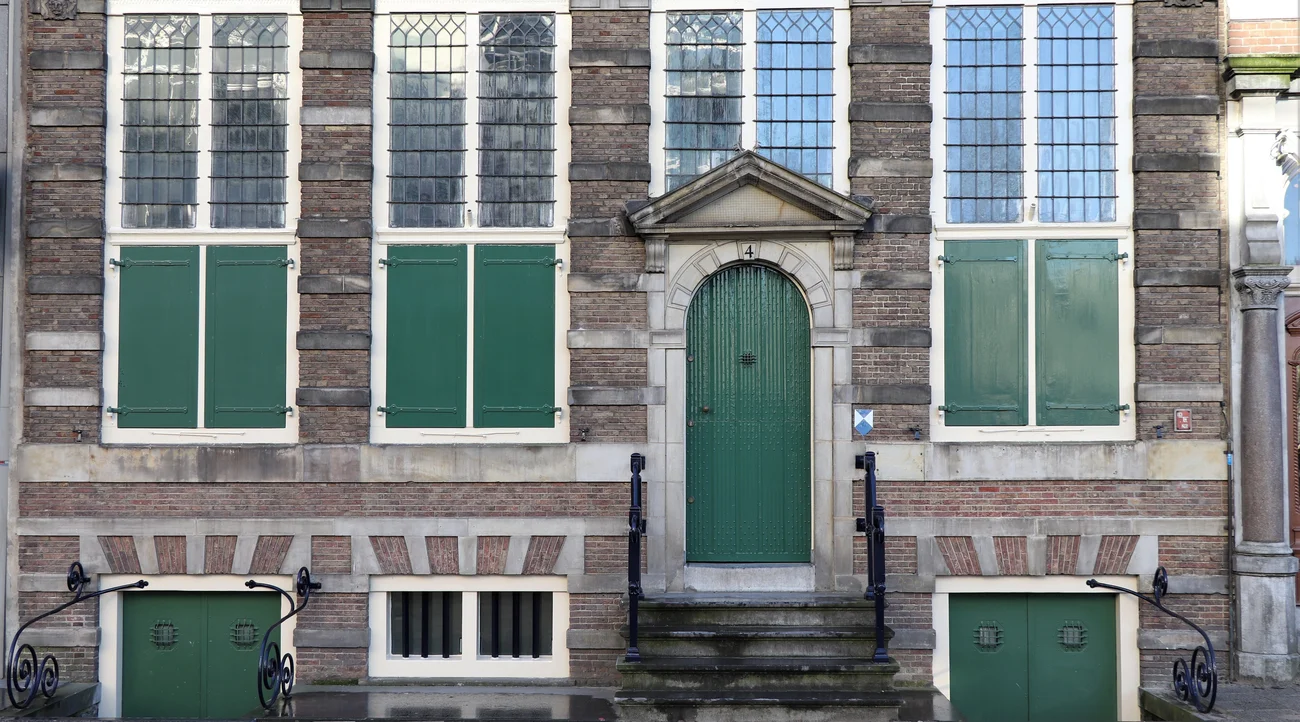
The bridge links Amstelstraat, close to Rembrandtplein, with Waterlooplein and Nieuwe Amstelstraat. Waterlooplein metro station is a convenient starting point. From the eastern historic centre, it is also an easy addition to a walk around the Rembrandt House Museum and the Amstel.
The making of the 1883 Blauwbrug
The current Blauwbrug opened in 1883. The municipal Public Works department commissioned architects Bastiaan de Greef and Willem Springer to create a more monumental Amstel crossing. The project coincided with Amsterdam’s International Colonial Exhibition, whose name and setting belong to the city’s nineteenth-century colonial history.
The bridge combined civic display with transport needs. The Amsterdam Omnibus Company contributed half the construction cost, linking its story with the development of urban public transport. Its elaborate appearance therefore formed part of everyday city infrastructure rather than a decorative crossing without a practical role.
The name survived from an earlier bridge whose timber was painted blue. It does not mean that the present bridge was designed as a uniformly blue structure. The current design brings together different materials and colours, including pale stonework, darker metalwork and red granite columns.
The architectural approach is usually described as Eclectic: ornament and historic references were combined to create a grand public work. The maritime decoration makes sense beside the Amstel, tying a busy crossing to the identity of a city shaped by water and navigation.
Later engineering changes are part of its working history; the architectural inventory records alterations in 1938. Viewing the bridge today means reading both its nineteenth-century ambitions and its continuing use as a connection between two parts of central Amsterdam.
Ships, crowns and the Blue Bridge name
- The official bridge number is 236.
- The Blue Bridge name comes from a predecessor’s painted timber.
- The sculpted piers take the form of ships’ bows.
- The crowned columns and paired lanterns turn functional bridge equipment into part of the architectural composition.
Discover Rembrandt and city walks by the Amstel
Stay near Waterlooplein and the Amstel
Accommodation around Waterlooplein, Rembrandtplein and the Amstel puts several central walking routes close at hand. Compare transport connections, room access and noise reviews, as nearby streets can have different evening atmospheres. The map is centred on Blauwbrug; check prices for your own dates.
Blauwbrug: frequently asked questions
More activities and experiences in Amsterdam