[linguise]

Gothic Quarter

Wander through shadowy alleys, Roman fortifications, and soaring gothic arches in the historic center

In short

Extending across the core of ancient Roman Barcino, this dense labyrinth of sandstone passages preserves two thousand years of continuous urban civilization. Soaring gothic churches, peaceful cloistered courtyards, and shadowed alleys open unexpectedly onto lively tavern-lined plazas, creating an intoxicating environment where centuries of administrative authority coexist with contemporary buskers and tapas counters.

  • Epicenter of Roman origins and Catalan medieval sovereign power
  • Dominated by the monumental Cathedral of the Holy Cross and Saint Eulalia
  • Completely pedestrianized web of narrow shaded cobblestone streets
  • Home to hidden plazas, artisan leather workshops, and historic chocolateries
  • Preserved ancient Roman fortifications, towers, and subterranean ruins

☰ Table of content

What to know before visiting

Centuries of layered stone architecture hide quiet cloistered courtyards right beside bustling commercial lanes.

Strenghts

  • Incomparable historic medieval atmosphere.
  • Completely pedestrianized street network.
  • Abundant tapas bars and cafes.
  • Central location near all transit.

To keep in mind

  • Heavy pedestrian tourist crowds.
  • Frequent GPS navigation signal drops.
  • Widespread pickpocketing along alleys.
  • Uneven stone cobblestone paving.

What to see in the Gothic Quarter

Layered Roman foundations, sovereign medieval palaces, and hidden squares reward patient on-foot exploration.

1

Cathedral of Santa Eulàlia City symbol

A majestic 14th-century Catalan Gothic cathedral featuring an open cloister inhabited by thirteen white geese.

2

Pont del Bisbe

An exquisite neo-Gothic marble enclosed bridge built in 1928 connecting the government palace to residential quarters.

3

Plaça del Rei

A dramatic, enclosed medieval royal palace courtyard housing the subterranean Roman ruins of the MUHBA museum.

4

Plaça de Sant Felip Neri

A tranquil historic square anchored by a Baroque church facade bearing tragic 1938 Civil War shrapnel scars.

5

Plaça de Sant Jaume

The historic civic forum where the City Hall and the Palau de la Generalitat face each other across stone flagstones.

6

Temple of Augustus columns

Four colossal 1st-century BC Corinthian stone columns preserved inside a private medieval residential courtyard.

7

Plaça Reial

A grand 19th-century neoclassical square flanked by porticoes, palm trees, and ornate streetlamps designed by Antoni Gaudí.

8

Carrer del Bisbe and the Roman walls

Stout defensive sandstone towers and gateway arches that protected the original Roman colony of Barcino.

The visit at the Gothic Quarter

Navigating these historic cobblestones becomes effortless once you orient yourself around the cathedral spire.

The best activities in the surroundings

Weaving through the district requires only stepping into any opening lane without paying admission for the streets.

Powered by GetYourGuide

Good to know

  • Tall residential buildings consistently disrupt smartphone mapping accuracy.
  • Bag snatchers target distracted pedestrians on congested intersections.
  • Wheeled luggage rattles loudly across the historic cobblestones.
  • Church services in the facing basilica require quiet behavior in the square.

Practical tips

  • Put away your map and enjoy getting temporarily lost in the alleys.
  • Order thick hot chocolate with churros along Carrer de Petritxol.
  • Look up above door lintels to spot carved medieval guild crests.
  • Visit late in the evening to hear acoustic violinists playing under stone arches.

How to reach Gothic Quarter

Every primary metro and bus route through central Barcelona drops you along the district borders.

Metro

Jaume I station (Line L4) sits directly in the center; Liceu (Line L3) borders the western edge along La Rambla.

Bus

Lines 47, 59, 120, V13, V15, and V17 circle the exterior avenues along Via Laietana and Port Vell.

Walking

Head directly south across the street from Plaça de Catalunya to enter the northern gateways.

Barri Gòtic, Ciutat Vella

History of the Gothic Quarter

The foundations of the Gothic Quarter were laid around 15 BC when Roman legionaries established the colony of Iulia Augusta Faventia Paterna Barcino on the small elevation of Mons Taber. Encircled by formidable stone walls punctuated by seventy-eight defensive towers, this military garrison gradually transformed into a vital maritime port.

Following the Visigothic period, the arrival of the counts of Barcelona in the early Middle Ages propelled the settlement into a bustling sovereign hub, which expanded outward through dense stone construction.

Between the 13th and 15th centuries, the district reached its golden age as the maritime capital of the Crown of Aragon. Wealthy merchants, stone guilds, and royal rulers financed the construction of monumental civic monuments, including the towering Cathedral of Santa Eulàlia, the expansive throne halls of the Grand Royal Palace, and the governing halls of the Generalitat. 

The area housed distinct artisan quarters alongside the Call, Barcelona’s vibrant medieval Jewish community, whose stone residences still line the western alleys. In the late 19th and early 20th centuries, municipal authorities launched an ambitious urban campaign ahead of the 1929 International Exposition to restore and unify the historic fabric. 

Architects like Adolf Florensa and Joan Rubió restored deteriorating medieval masonry, moved endangered gothic facades from surrounding areas into the quarter, and added neo-Gothic embellishments like the famous Pont del Bisbe bridge. Today, the Gothic Quarter stands as a layered living archive where Roman ruins, authentic medieval stone, and 20th-century preservation craft a mesmerizing urban reality.

Curiosities about the Gothic Quarter

  • Exactly thirteen white geese inhabit the cathedral cloister, honoring Saint Eulalia’s age when martyred.

  • Architect Joan Rubió hid a small carved human skull with a dagger beneath the Pont del Bisbe bridge.
  • Street names like Carrer de la Boqueria and Carrer dels Sombrerers reflect ancient medieval artisan guilds.
  • The highest natural hill of Roman Barcino, Mons Taber, rises barely sixteen meters above sea level.
  • Subterranean Roman laundry and wine-making vats remain preserved beneath modern plaza flagstones.

Tickets and tours in Barcelona

Find your stay near Gothic Quarter

Reserving a room inside a converted centuries-old palazzo puts historic stone arches right outside your bedroom door.

Best restaurant in the neighborhood

Can Culleretes

Barcelona's oldest documented restaurant, opened in 1786, serving hearty Catalan heritage recipes like cannelloni and wild boar stew inside classic wood-paneled dining rooms.

Carrer d'en Quintana, 5

La Plata

A tiny historic corner bodega founded in 1945, beloved for dispensing house red wine straight from wooden barrels alongside four simple, perfected tapas including fried sardines and tomato salad.

Carrer de la Mercè, 28

Els Quatre Gats

A storied modernist tavern established in 1897 inside a Puig i Cadafalch building, once the favored intellectual meeting ground where Pablo Picasso held his first solo art exhibition.

Carrer de Montsió, 3

Frequently Asked Questions - FAQ

Is the Gothic Quarter completely medieval?

No, while its core layout and primary monuments are genuinely medieval and Roman, several facades and bridges were added or restored in neo-Gothic style during the 1920s.

The quarter is generally safe and well-lit with active restaurants, but caution against pickpocketing is essential in deserted side alleys late at night.

Except for emergency services, postal vans, and scheduled early morning deliveries, the entire quarter is closed to private vehicle traffic.

Thirteen white geese live in the open courtyard cloister to commemorate Saint Eulalia, the city’s co-patron saint who was thirteen years old when martyred.

Yes, the district hosts several acclaimed plant-based cafes and organic bistros tucked along streets like Carrer dels Escudellers.

Portions of the Roman defensive walls, gate bastions, and the temple columns on Carrer del Paradís are completely free to view.

Most main thoroughfares are flat and paved, but historic side alleys feature uneven cobblestones and occasional stone curbs.

Carrer de Petritxol, known locally as the street of chocolate, houses iconic historic cafes like Granja La Pallaresa and Granja Dulcinea. See the best restaurants and bares in the Gothic Quarter.

More activities and experiences in Barcelona

You might also be interested in...

The journey continues…

Bus in Barcelona Placa de Espanya
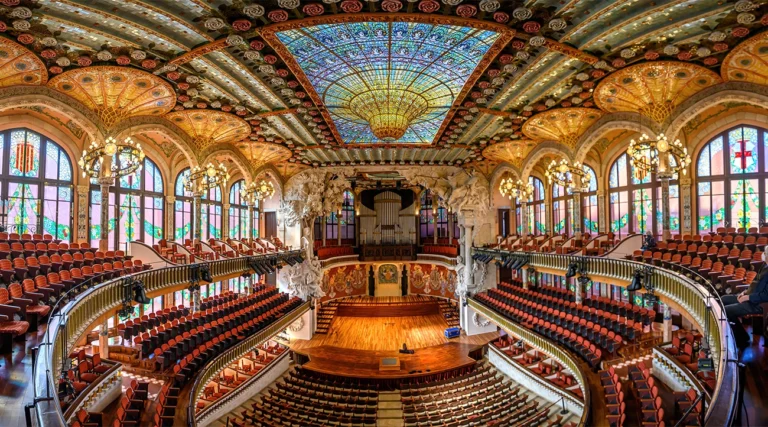
Palau de la Musica Catalana main hall
Placa de Vicenc Martorell
Tapas bar blackboard in Barcelona
Restaurant near Park Guell in Barcelona
Barcelona romantic hotel with Cathedral vista

Must-Do Activities & Tours

Share:
Prev
El Born
Next
Font de Sant Just: purest gothic heritage