[linguise]

Recinte Modernista de Sant Pau guide: history of the Art Nouveau former hospital

Explore Lluís Domènech i Montaner’s Garden Hospital Landmark in Eixample

In short

The Recinte Modernista de Sant Pau stands as the world’s largest Art Nouveau complex. Designed by architect Lluís Domènech i Montaner as a revolutionary garden hospital, this UNESCO World Heritage site features colorful tiled pavilions, secret underground tunnels, and peaceful landscaped courtyards.

  • The largest Modernist architectural complex in Europe
  • Designed by Lluís Domènech i Montaner as an open-air pavilion hospital
  • Network of underground brick tunnels connecting all major buildings
  • Striking ceramic mosaics, stained glass, and decorative sculptures
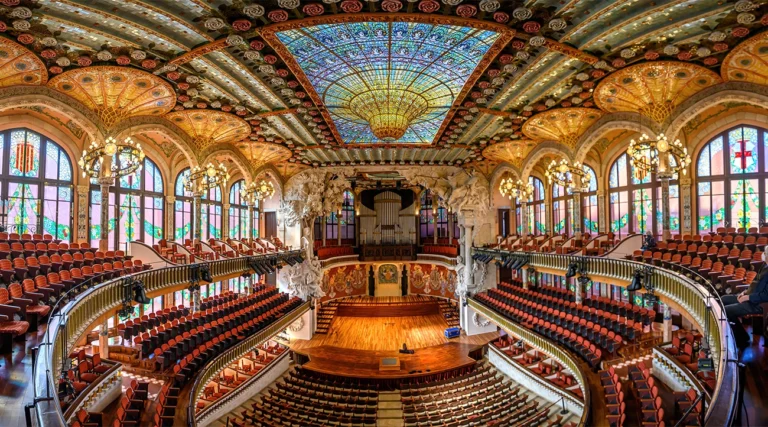
  • Inscribed as a UNESCO World Heritage site alongside Palau de la Música Catalana

☰ Table of content

Prices and opening times of the Recinte

Here the operating schedules and general entry costs before booking your visit:

Hours

  • Summer hours 09:30 - 18:30
  • Winter hours 09:30 - 17:00
  • Last entry 30 mins prior
  • Closures

    25 december

Prices

  • Standard from 18€
  • Reduced price from 13€

    Under 24, over 65, people with disabilities under 65%

  • Free entry 0€

    Under 12, people with disabilities over 65%, 23 abril, 24 september, Night of the museums

What to see in the Recinte

We present you the essential architectural features and restored pavilions:

1

Administration Pavilion Iconic

The grand front building featuring dramatic stained glass, soaring ceilings, and intricate mosaic floor patterns.

2

Underground Tunnels

Subterranean brick galleries built to transport patients and medical supplies between pavilions.

3

Sant Salvador Pavilion

Exhibition space chronicling the history of medicine in Barcelona and the life of architect Domènech i Montaner.

4

Sant Rafael Pavilion

Restored historical ward depicting early 20th-century hospital life, complete with period equipment.

5

Central Gardens

Outdoor landscaped courtyards designed with aromatic plants to support patient healing.

Quick summary of a Recinte visit

Keep these quick practical details in mind when planning your itinerary:

How to visit the Recinte

Select between standard self-guided access, audio-guided tours, or combined Modernist passes:

Good to know

  • The site spans a large outdoor area
  • Restored buildings and paved pathways
  • Gravel paths and concrete tunnels
  • High-visibility signage directs

Practical tips

  • Tickets booked for entry after 14:00
  • Pair your visit with a walk down Avinguda de Gaudí
  • Consider a combined ticket with Palau de la Música Catalana
  • Capture the main facade framed by trees

How to reach the Recinte

Move to this northeastern Eixample landmark conveniently via public transport:

Metro

Line L5 (Blue) to Sant Pau | Dos de Maig or Line L4 (Yellow) to Guinardó | Hospital de Sant Pau.

Bus

Routes 19, 47, D50, H8, and V23 stop right outside the entrance gates.

Walking

A scenic 15-minute walk straight up Avinguda de Gaudí from Sagrada Família.

Carrer de Sant Antoni Maria Claret, 167, 08025

History of the Recinte

The origin of the Hospital de Sant Pau dates back to 1401, when six small medieval hospitals in Barcelona merged into a single institution. By the late 19th century, the growing city population overfilled the original Gothic hospital building in El Raval.

Catalan banker Pau Gil i Serra left instructions in his will to fund a modern, state-of-the-art hospital that would combine cutting-edge hygiene standards with inspiring design. Architect Lluís Domènech i Montaner was commissioned to design the new complex in 1901. 

Rejecting the bleak hospital models of the era, he envisioned a “city within a city”—an open-air complex of isolated pavilions set within gardens, angled south-east to maximize sunlight exposure and ventilation. Underground tunnels were constructed to move patients out of the cold weather, while colourful tilework provided a cheerful environment for recovery.

Construction proceeded in two phases, with Domènech i Montaner overseeing the project until his death in 1923, after which his son Pere Domènech i Roura completed the complex in 1930. The hospital operated continuously for nearly a century until medical operations transferred to a new modern facility nearby in 2009. Following a painstaking restoration, the historic complex reopened as an international cultural center and museum in 2014.

Curiosities about the Recinte

  • Domènech i Montaner believed that natural beauty and colorful art were essential for healing human illness.
  • The entire complex was angled diagonally against Eixample’s grid system to align with natural light and sea breezes.
  • Each medical department was originally housed in a separate pavilion to prevent the spread of infectious diseases.
  • Over one kilometer of subterranean brick tunnels runs beneath the open-air gardens.
  • The site shares its UNESCO World Heritage designation with Palau de la Música Catalana, both listed in 1997.

Tickets and tours Recinte de Sant Pau

Find your stay near the Recinte

Analyze recommended hotels and apartments situated around the upper Eixample and Guinardó areas:

Frequently Asked Questions - FAQ

Is Recinte Modernista de Sant Pau still an active hospital?

No, medical operations moved to a modern building adjacent to the site in 2009, leaving the historical pavilions open as a museum complex.

A self-guided tour exploring the pavilions, underground tunnels, and gardens typically takes 1.5 to 2 hours.

Yes, ramps, elevators, and wide flat garden pathways make the entire site accessible for visitors with reduced mobility.

Yes, a direct pedestrian avenue (Avinguda de Gaudí) links the two landmarks via a 15-minute walk.

Many major tourist passes include discounted admission or free entry to the site.

Yes, entry is traditionally free on Sant Jordi (April 23), the Night of the Museums, and La Mercè (September 24).

While information panels are clear throughout, an audio guide adds deep historical context regarding the medical and architectural design.

Personal photography for non-commercial use is permitted throughout all outdoor gardens, pavilions, and tunnels.

More activities and experiences in Barcelona

You might also be interested in...

The journey continues…

Woman eating street food in Barcelona
Parque del Laberint d'Horta landscape
El Born aerial view in Barcelona
Guadì houses on Passeig de Gràcia
Montserrat Monastery Landscape
Barcelona Cathedral front view

Must-Do Activities & Tours

Share:
Prev
Palau de la Música Catalana: info, prices and hours of the Modernist hall
Next
Picasso Museum Barcelona guide: artwork and palace history