In short
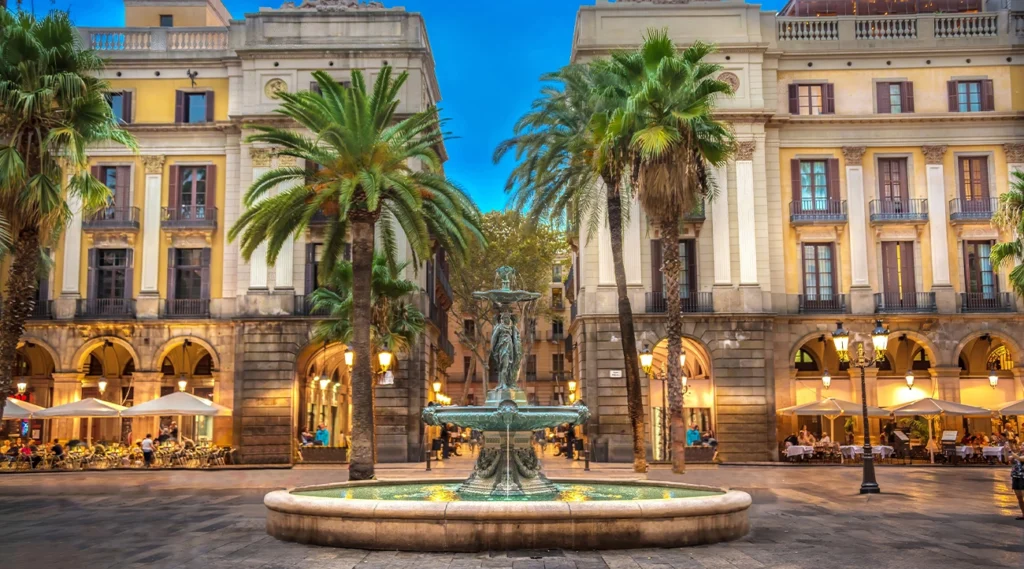
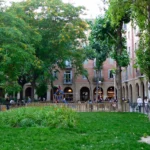
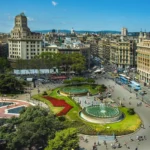
Concealed just footsteps east of La Rambla, this porticoed square stands as one of the most animated open spaces in the historic center. Designed in a formal neoclassical style, its warm ocher facades frame towering royal palms, vibrant outdoor restaurant terraces, Antoni Gaudí’s earliest municipal lampposts, and a historic cast-iron fountain celebrating classical mythology.
- Harmonious 19th-century neoclassical porticoed square
- Elaborate six-armed lampposts created by Antoni Gaudí
- Majestic central Three Graces cast-iron fountain
- Towering mature royal palm trees lining all sides
- Historic nightlife institutions, live jazz clubs, and outdoor dining
☰ Table of content
The perfect stop
Vibrant cafe terraces and street life make this sheltered square a prime gathering spot throughout day and night.
-
Recommended stop time 45'
Provides the perfect duration to admire the Gaudí lanterns, circle the fountain, and savor a beverage at an outdoor cafe.
-
Local customs
Residents meet under the covered arches for afternoon vermouth, collectors trade coins and stamps on Sunday mornings, and music enthusiasts gather outside historic jazz cellars.
What to see in Plaça Reial
Architectural symmetry, pioneering modernist metalwork, and classical civic emblems define this lively monumental courtyard.
Gaudí lampposts Historic
Six-armed wrought-iron streetlamps topped with winged helmets and coiled serpents created in 1879.
Font de les Tres Gràcies
A stately cast-iron fountain honoring the classical mythological Graces, sculpted by Antoine Durenne.
Neoclassical porticoes
Continuous vaulted ground-floor arcades sheltering bustling tapas bars, vintage shops, and sheltered walkways.
Royal palm grove
Dozens of towering palm trees creating a tropical silhouette against the uniform yellow buildings.
Passatge del Rellotge
An atmospheric vaulted alleyway leading visitors through narrow passages into surrounding medieval streets.
Quick summary of Plaça Reial
Practical visit criteria help maximize your time in this famous Gothic Quarter landmark.
Best moment
Early evening
Crowd
Consistently bustling with diners
Kid friendly
High, traffic-free stone
Unmissable
Inspecting the coiled serpents atop Gaudí's lanterns
Type of experience
Historic urban architecture, outdoor cafe culture, and nightlife
What to expect
Street entertainers, cafe seating, evening music, and porticoes
Explore the squares of Barcelona
Pedestrian arcades and multiple alley entrances make accessing the square seamless from nearby thoroughfares.
Good to know
- Terrace cafes often charge higher prices than elsewhere.
- Watch personal bags carefully against skilled local pickpockets.
- Nightclubs bring noisy crowds late on weekend evenings.
- Motor vehicles are prohibited across the entire stone surface.
Practical tips
- Grab a shaded outdoor table under the arches.
- Catch world-class live jazz inside basement club Jamboree.
- Enter through Passatge de Bacardí for historic atmosphere.
- Photograph the square at sunset for golden facade reflections.
How to reach Plaça Reial
Convenient access points connect La Rambla directly to the open plaza flagstones.
Line L3 (Green) to Liceu station, followed by a two-minute walk south along La Rambla turning into Carrer de Colom.
Lines 59 and V13 stop along La Rambla directly outside the passage entrances.
A five-minute walk west from Plaça de Sant Jaume cutting down Carrer de Ferran.
Plaça Reial, Ciutat Vella, 08002
Official Transport in Barcelona
History of Plaça Reial
The urban space occupied by Plaça Reial was once the site of the Capuchin Convent of Santa Madrona, an extensive religious complex established in the early 17th century. Following the ecclesiastical confiscations enacted in 1835 under Prime Minister Juan Álvarez Mendizábal, the monastic buildings were secularized and subsequently demolished.
Read allShow less
Read allShow less
The City of Barcelona seized the opportunity to address severe overcrowding within the walled medieval core by creating a grand, dignified civic plaza modeled after prestigious royal squares in Paris and Madrid.
Municipal architect Francesc Daniel Molina won the public design competition in 1848, conceptualizing an enclosed, symmetrical square framed by noble residential mansions. Molina unified the complex through continuous ground-floor porticoes supported by classical arches, topped by monumental pilasters, terra-cotta reliefs, and stately balustrades.
Construction progressed between 1848 and 1859. The original plan called for an equestrian statue of King Ferdinand the Catholic in the center, but the project stalled, leading to the installation of the French cast-iron Fountain of the Three Graces in 1876.
In 1879, the newly qualified architect Antoni Gaudí received his very first official commission from the city council to design ornate gas streetlights for the square, forging a lasting artistic legacy. While the square suffered significant urban degradation and crime during the mid-20th century, a comprehensive municipal restoration led by architects Federico Correa and Alfonso Milà in 1982 pedestrianized the space, planted tropical royal palms, and revitalized the arcades.
Today, Plaça Reial endures as a vibrant symbol of 19th-century urban elegance and a bustling heart of Barcelona’s nightlife.
Curiosities about Plaça Reial
- The two central streetlamps represent Antoni Gaudí’s first public work for Barcelona.
- Architects originally planned a colossal equestrian statue of King Ferdinand for the center.
- Stamp and coin collectors have met here every Sunday morning since the 19th century.
- Famous surrealist artist Salvador Dalí occasionally stayed at a hotel overlooking this square.
- Passatge de Bacardí, built alongside the square, was Barcelona’s very first covered shopping gallery.
Tickets and tours in Barcelona
Find your stay near Plaça Reial
Charming boutique hotels situated around the square offer direct access to historic Old Town nightlife.
Frequently Asked Questions - FAQ
Is Plaça Reial open to the public at night?
Yes, the square remains completely open twenty-four hours a day, serving as a lively center for late-night dining and clubs.
Did Antoni Gaudí really design the streetlamps in Plaça Reial?
Yes, the two six-armed iron lanterns with winged helmets were Gaudí’s first municipal commission after finishing architecture school.
Are there good restaurants and tapas bars on Plaça Reial?
Yes, numerous cafes and restaurants line the perimeter porticoes, offering outdoor terrace dining ranging from tapas to paella.
Is Plaça Reial pedestrianized?
Yes, the entire square is fully pedestrianized, keeping the stone flagstones entirely free from automotive street traffic.
What happens in Plaça Reial on Sunday mornings?
Every Sunday morning, the square hosts a traditional open-air collector’s market specializing in vintage stamps, coins, and postcards.
Is Plaça Reial safe to visit late in the evening?
The square is well lit and heavily populated, though standard awareness of pickpockets is recommended around crowded terraces.
Can you visit the famous jazz club Jamboree in the square?
Yes, Jamboree operates nightly in the historic brick-vaulted cellars beneath the porticoes, offering live jazz and dance sessions.
How far is Plaça Reial from La Rambla?
Plaça Reial sits barely thirty meters east of La Rambla, connected through short pedestrian passages like Carrer de Colom.